


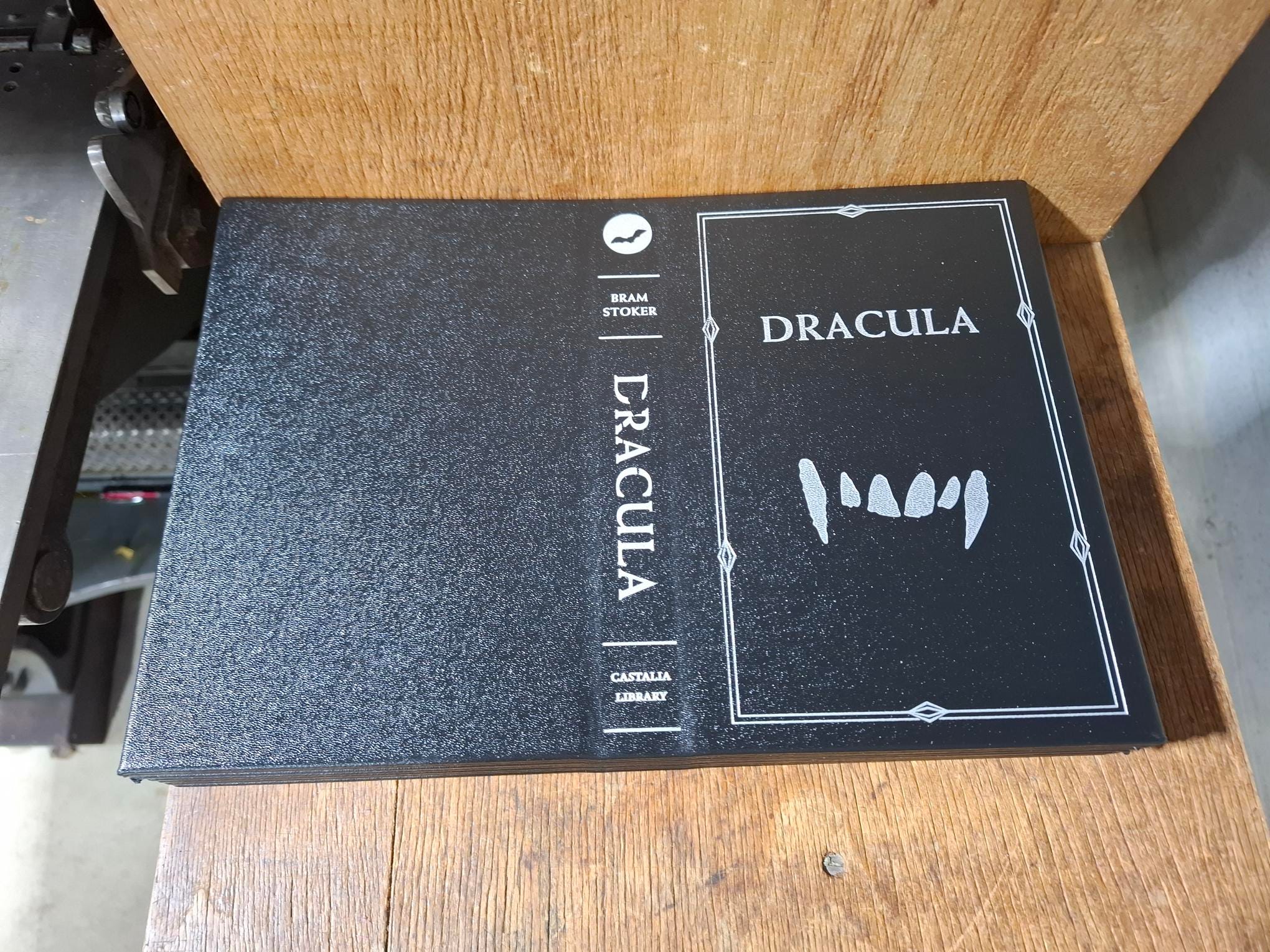
As you can see, we’ve begun stamping DRACULA. That’s not a stamping mistake on the D and the R, that’s where the red foil will appear. Obviously, we have to stamp all the silver before we stamp the red, so we’ll post the completed stamps when they’re done. However, if you look at the lines on the cover, you can see how clean and precise our newly-renovated press is operating.
In other news, THE KISO SCROLL, complete with its cover, has now gone out to all the paid subscribers and is available on Amazon for anyone else who would like to read it. The price is reduced since it’s a much shorter book than the others for some reason.

The third book of The Secret Scrolls of Naruto takes the pursuit out of the back alleys of Edo and up the Nakasendō, where the conspiracy climbs from city shadow into open mountain country. Three wicked rōnin push north through Usui Pass after Otsuna and the Tenma detective Mankichi: one with his arm in a sling from a wound that should have killed him, one strolling as though bound for a teahouse, one burning with the heat of his grudge with every league he walks. Somewhere ahead of them walks the swordsman-monk Norizuki Gennojō, who has already drawn blood in Edo and will draw more. And far to the south, deep in the sealed domain of Awa, a woman travels upriver toward Tsurugi-san with a servant and an errand she will not name.
The steam and sulphur of the Suwa bathhouses at evening, an eccentric scholar drifting through the Kiso-Fukushima checkpoint in search of hairpins and dried char, a midnight brawl and a hunted man in a hot-spring bath, and at last, the great confrontation on Mochinoki Slope under diamond clouds that hide the spring moon — this is the book where Yoshikawa Eiji takes his grand adventure out of the city and into the mountains.
The Kiso Scroll is the third book in the first English translation of Yoshikawa Eiji’s Naruto Hichō, the century-old serial series that made him the most widely read author in Japanese history. Translated in literary prose that reads as though it were originally composed in English, it brings the novel that created the modern Japanese adventure genre to the English-speaking world for the first time.
Become a paid subscriber to the Library if you’d like to support our translation efforts and receive a new translation every week. Once Naruto Hicho is complete, we’ll move on to the first volumes of the legendary Episodios Nacionales by one of Spain’s greatest writers, Benito María de los Dolores Pérez Galdós.
Bruh.
Read the book and you’ll see you got the teeth wrong.