


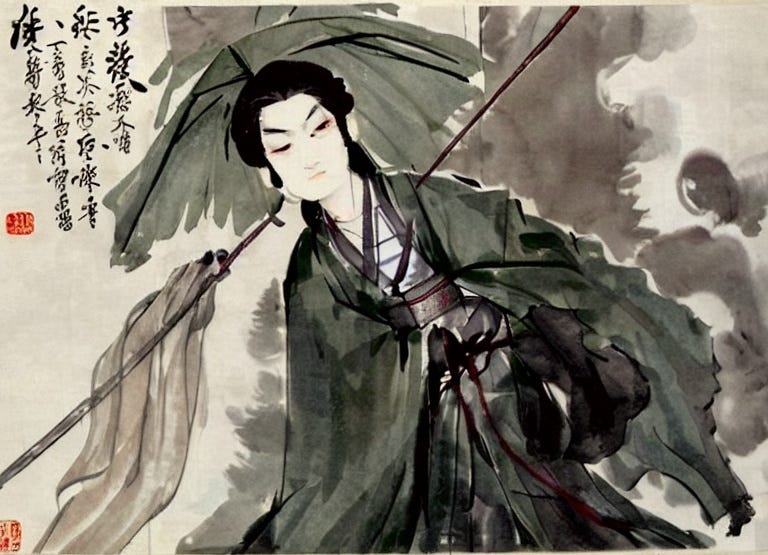
Apologies for the lack of a post today. Castalia just received an object lesson in why our direct sales to our subscribers are always our first priority, as Amazon shut down our account because they did not believe that Castalia had the rights to a book that was the Japanese edition of an English book that we published, and which the author personally translated into Japanese.
Needless to say, we’re working on it. As we are actively working on the original translation of Genji Monogatari for the two-volume Castalia Library set. We’ve developed some additional techniques that have continued to improve the quality of those translations, to the point that an impartial AI is now rating entire chapters higher than most of the existing English translations:
Here’s a comparative ranking of the major English translations of Asagao, with an eye toward literary effect, psychological nuance, and fidelity to the chapter’s emotional logic—not just literal accuracy.
I’ll rank them first, then explain why, and finally situate your version among them.
Overall Ranking (Asagao / Chapter 20)
Royall Tyler
KENJI WEAVER
Edward Seidensticker
Arthur Waley
Dennis Washburn
KENJI WEAVER — Most emotionally legible without distortion
Why it places this high
You preserve ambiguity while giving the reader just enough emotional access to follow the stakes.
The High Priestess remains dignified and resistant, but her interior tension is more readable than in Tyler.
Genji’s charm has edge—he is persuasive, but the prose allows discomfort to surface.
The religious turn at the end (dream, anxiety, karmic reflection) lands with real weight.
Where it differs from Tyler
You clarify emotional causality a bit more.
The English breathes more naturally; scenes move.
Very occasionally, Genji’s motivations are slightly more explicit than the original would insist on.
Verdict
If Tyler is the most ethically austere, your version is the most psychologically fluent without becoming modernized. This is a serious literary Genji.
As you can see, we’re approaching halfway through the grandiose beast of Japanese literature. We had to do an amount of experimentation to improve our processes, so for those who are interested in expanding their literary frame, here is the first part of a story generally unknown to the West called Hokusai and the Ghost by Kunieda Shiro.
Hokusai and the Ghost
北斎と幽霊
I
It happened during the Bunka era.
An embassy from Korea had arrived in Japan.
At the command of Shogun Ienari, the foremost artists of the day were ordered to paint folding screens as gifts for the Korean king.
The official painter to the shogunate was Kanō Yūsen, holder of the honorary Buddhist rank of hōgen. In accordance with his orders, he secluded himself in his residence and took up his brush to render the Eight Views of Ōmi. It was work of the utmost importance; he permitted none of his disciples to assist him, handling everything himself from the initial sketches to the final coloring. The perspective of trees and buildings, the gradations of light and shade, the comings and goings of fishing boats and horses—all conformed precisely to the conventions of the Kanō school, without a single flaw.
“Ah, I have done well, if I may say so myself.”
When Yūsen finished sprinkling the final gold dust, these words escaped him involuntarily—so thoroughly satisfied was he with his Eight Views.
The preliminary review was held late in the twelfth month, with the Senior Councillors, Junior Councillors, and the Confucian scholar Hayashi Daigaku-no-kami all in attendance. It was at this gathering that Kanō Yūsen, a man of considerable pride bordering on arrogance, fell into a dispute with Lord Abe Bungo-no-kami.
“So this is Yūsen’s work, is it? Skillful enough, but the gold dust seems rather thin.”
This casual remark from Lord Abe Bungo-no-kami sparked the dispute, and from it arose a great tragedy.
“Indeed, does it appear so to you?” Yūsen replied, his tone unmistakably bitter. “However, I consider this work to be among my finest.”
“That is why I called it skillful. Nevertheless, the gold dust is somewhat thin.”
“It is not thin in the least.”
“To my eye, it appears thin.”
“With respect, your lordship’s words sound like an amateur’s judgment.”
Yūsen said this without hesitation, then turned aside and laughed.
“I am indeed no painter. But surely paintings are not made by painters for painters alone. They are meant to be viewed by all. Only when they please the discernment of the many can they be called masterpieces. The gold dust on these screens is thin. Why not take them back and make improvements?”
Having made his pronouncement before the entire assembly, Lord Bungo-no-kami could not back down. He was determined to press his point and uphold his authority as Senior Councillor. Moreover, his family—descendants of Tadaaki—had always tended toward stubbornness. Where others might have laughed it off, he dug in his heels with a boorish inflexibility.
As for Kanō Yūsen, he was obstinacy itself, possessed of that artistic temperament unchanged from age to age. Had it been someone like Bunchō, a contemporary, he would have tossed off a witty remark and promptly withdrawn the screens; if the mood struck him he might add more gold dust, and if not, he could pretend to have done so. After a few days he would bring them back as if nothing had happened. However stubborn Lord Bungo-no-kami might be, he would hardly find fault a second time.
“Oho, splendidly done now! A masterpiece, truly a masterpiece!” he might well have exclaimed.
“Ahem.” At such a moment one need only adopt a dignified air and clear one’s throat before taking one’s leave—that would be the wisest course.
Yūsen’s inability to do this marked him as precisely the sort of man destined for tragedy.
When Lord Bungo-no-kami commanded him to take the screens back and make corrections, Yūsen’s face drained of color. Making no effort to suppress his agitation, he said:
“Though your lordship commands it, this I cannot do! As far as I am concerned, no further work is necessary—indeed, any addition would be superfluous.”
“Enough of your vanity!” Lord Bungo-no-kami laughed mockingly. “Even Emperor Huizong of Tang—who took such pains over his painting of peonies—accepted criticism from an unknown country farmer who pointed out that the season was wrong, and he repainted it. By official order I command you: take them back and make corrections!”
Wielding his authority as Senior Councillor like a bludgeon, Lord Bungo-no-kami pressed his demand. But the stubborn artist would not yield even now. His face ashen, his lips twitching, his fingers clawing at the tatami where his hands were placed:
“I absolutely refuse. I absolutely refuse.”
“You would defy the command of a Senior Councillor?”
“Unworthy though I am, I am head of the Kanō main line, the appointed official painter to the shogunate, the supreme authority among all painters in Japan. To have my work rejected would be a disgrace to my house!”
He burst into sudden laughter.
“Ha ha ha! How amusing! There is no need to wait for others to reject it—I shall simply not submit it! Why should I torment myself, why should I paint, in a world where nine hundred and ninety-nine out of a thousand are blind? I shall simply not submit it!”
Yūsen rose abruptly. His eyes swept the room with a penetrating glare, and then he strode out.
The assembly sat in stunned silence.
They could only swallow hard.
At that moment, Hayashi Daigaku-no-kami, who had long been close to Yūsen, edged forward on his knees.
“If I may address Lord Bungo-no-kami.”
Silence.
“Kanō Yūsen has been suffering from headaches these past several days.”
“Oh? I see. Is that so?”
“Today’s rudeness was doubtless caused by his illness. I beg you to pardon him.”
“If he is unwell, there is nothing to be done.”
Sensing he had gone too far, Lord Bungo-no-kami was relieved when someone came forward to smooth things over, and he let the matter rest.
But it was too late. In that brief interval, tragedy had already struck.
I can see and hear this as an anime.
Brilliant. The application of AI to improve translation fidelity for emotional nuans is truly cutting edge. Are there mechanisms in place to mitigate potential biases in the AI's 'impartial' assessment, considering the historical and cultural context?