


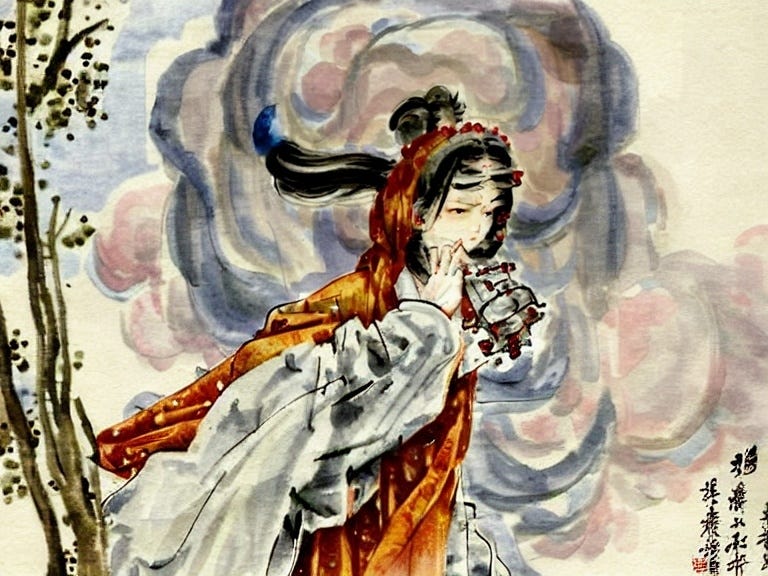
Hokusai and the Ghost
北斎と幽霊
IV
Nearly half a year passed after these events. Hokusai remained as poor as ever.
One day a man who appeared to be a head clerk from a prosperous shop came to visit. He had come to commission a painting for a banner to display at his master’s son’s Boys’ Day Festival.
“There are other fine painters. Why commission a talentless fellow like me?”
With his usual brusqueness, Hokusai asked this in apparent puzzlement.
“Well, sir, as to that: my master, though a merchant, is a man of refined tastes. He has long been fond of painting and calligraphy, and has enjoyed the patronage of Master Bunchō. He has heard many things about the art world from him. On this occasion, concerning the Boys’ Day banner, he sought Master Bunchō’s opinion, and the master said that the finest ukiyo-e painter today is surely Master Hokusai. My master was delighted and sent me at once with instructions to request your services by all means. That is why I have come so hastily today.”
“Then it was Master Bunchō who recommended me?”
“Yes, indeed.”
“Hmm.”
Hokusai suddenly folded his arms and began to groan.
In those days, Tani Bunchō was the official painter to the Tayasu branch of the Tokugawa family. His lifestyle rivaled that of a minor lord, and his circumstances were truly enviable. His residence, known as Shazanrō, drew only the cream of society; ukiyo-e artists like Hokusai could not have gained an audience even by making a hundred visits. And yet, wonder of wonders, Bunchō himself had praised him. Even the stubbornly uncouth Hokusai could not help but be moved.
“Very well,” Hokusai said, his face brightening with pleasure. “I shall put all my skill into it. I accept.”
“Ah, you consent at once! How pleased my master will be!”
With these words, the messenger took his leave.
From that day, Hokusai refused all visitors and shut himself in, devoting himself entirely to working out the design. Perhaps because he was trying too hard, the inspiration that usually flowed so freely would not come.
One day, while lost in thought, he made a pilgrimage to the Myōken Hall at Yanagishima, where he regularly worshipped. On his way home, a sudden thunderstorm overtook him. Hokusai, who hated thunder, turned pale with fright and ran headlong down the path through the paddies.
At that moment, a pillar of fire seemed to rise from an elm tree before him, and the world in every direction turned crimson. A crash of thunder deafened him. He lost consciousness—and in that instant a divine general appeared, his head towering into the clouds, his feet planted firmly on the earth, a figure of several dozen yards in height, an image of overwhelming majesty.
A nearby farmer helped him to his feet. Carried home in a palanquin, he went straight to his silk and took up his brush. What he painted in a single burst was a Shōki blazing as if on fire: the Red Shōki, a demon-queller in crimson alone, unprecedented in all the history of art.
The painting became the talk of all Edo, and overnight he rose to fame. For the first time he found confidence in himself. He produced one masterpiece after another: the Hundred Views of Fuji, The Fox’s Wedding, One Hundred Poems by One Hundred Poets Illustrated, the Hokusai Manga, The Conquest of Korea, the Teikin Ōrai, the Hokusai Gafu—each one fully realized as art and strikingly original.
Famous though he became, he never grew rich, for he had no head for making money.
He changed residences constantly. His wandering was legendary: in his lifetime he moved within Edo alone more than eighty times, nearly a hundred. Every house he moved into was notoriously squalid—partly from his own indolence, partly of course because he could not afford the rent on anything better.
This happened when he was living near the Ogyō Pine in Negishi. One day a splendid samurai arrived, followed by servants bearing many gifts, and called at Hokusai’s hovel.
“My master, Lord Abe Bungo-no-kami, has heard of your distinguished reputation and wishes to receive a carefully executed work from your own hand. I have been sent to convey this request. Will you consent?”
This was the messenger’s formal address.
At the name of Abe Bungo-no-kami, Hokusai’s expression changed abruptly. He said nothing, folding his arms and staring coldly at the samurai.
After a moment he spoke:
“What sort of painting does his lordship desire?”
“As to that, his lordship’s instructions are that it shall be left entirely to you.”
“I see.”
When he heard this, Hokusai suddenly smiled, a terrible smile.
“Very well. I shall paint it. Lord Abe is a hereditary lord of the highest standing—and moreover a Senior Councillor to His Excellency. To receive a commission from such a personage is an honor for any painter. I shall paint something that will make his lordship gasp with astonishment. Ha ha ha, I accept.”
Oh, man. This is going to end really badly.