


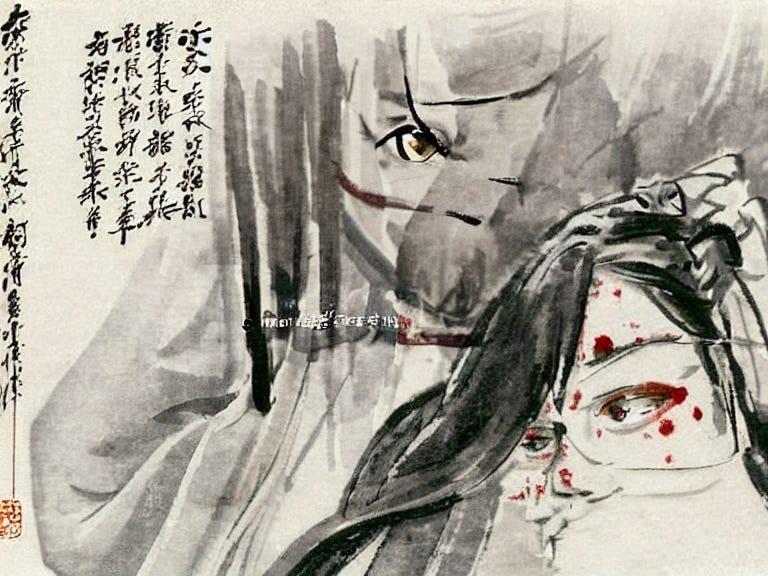
Hokusai and the Ghost
北斎と幽霊
V
From that day on, he closed his gate and refused all visitors. He would not even allow disciples or family into his studio.
His intensity was fearsome; his manner that of a madman. For a full twenty days he sat before the painting surface without rest. What in the world was he painting? No one knew. In any case, he used no sketches or studies of any kind. Today we would call them “models,” but he used nothing of the sort. He seemed to be painting entirely from imagination—or perhaps from memory.
On the twentieth day, he finished at last.
He let out a long breath. He gazed at the painting. His face showed exhaustion. When he twisted that exhausted face into a smile of satisfaction, he looked instead sorrowful and forlorn.
He rolled up the silk scroll, placed it carefully in the plain wooden box he had prepared, and sealed it.
He seemed relieved at last.
The next day a messenger came from the Abe household.
“Please present this directly to his lordship.”
With these words, Hokusai handed the wooden box to the messenger.
“As you wish.”
With a bow, the messenger departed.
Now the story moves to the Abe mansion.
It was late at night. Lord Bungo-no-kami was in his private chamber. He had just returned from his duties at the castle and had not yet changed out of his formal robes.
“Hokusai’s painting has arrived, you say? That was remarkably quick.”
He was in good spirits as he reached out and received the wooden box from Kinya, the retainer who had served as messenger.
“Let me see it at once. For a man as obstinate as Hokusai is said to be, he worked quickly enough. That must be because your address was well delivered. Ha ha ha.”
He was clearly pleased.
First he untied the cord around the box. Then he broke the seal with his fingers. Then he lifted the lid. Inside lay a rolled silk scroll.
“Kinya, trim the lamp. Now, what has he painted for me?”
Murmuring to himself, he took out the silk scroll and placed it on his lap.
“Kinya, hold it down.”
With that command, he unrolled the silk toward him. When it was fully open, he fixed his eyes upon it.
“What is this?”
“Ah! A ghost!”
The voices of Lord Bungo-no-kami and Kinya burst out together.
“Damn you, Yūsen!”
In the next instant, Lord Bungo-no-kami’s scream tore through the stillness of the mansion. Then came a groan—”Ahhh”—and the thud of a body falling. Lord Bungo-no-kami had apparently fainted.
When we speak of ghost paintings, we think of Ōkyo; when we think of Ōkyo, we think of ghosts. So famous have Ōkyo’s ghosts become. But the painting Hokusai created with deliberate intent and sent to Lord Bungo-no-kami, known as Ghost in a Palanquin, is itself a celebrated work of the supernatural.
A snowy dusk, white on white. An abandoned palanquin. Inside, an old man. His entrails spilling out. Blood scattered everywhere. And the old man’s eyes, burning with hatred. He is a ghost who is also human, a human who is also a ghost. And he is Kanō Yūsen.
* * *
“That is right. With my tools of the trade—my pigments, my brush, and my paper—I sought to avenge my master. I believed that even a man as stubborn as Lord Bungo-no-kami would lose consciousness the moment he saw that painting. I painted it with that purpose in mind.
“My calculation proved correct. It exceeded my expectations. Not long after, Lord Bungo-no-kami retired from office.
“I felt thoroughly vindicated. And I came to believe in my own powers more than ever. But I shall never paint another ghost. Why, you ask? The reason is simple: even if I were to paint one hereafter, I could never again produce a work with such force.”
These are the words Hokusai spoke to a certain person in later years.
If you enjoy this sort of things, original translations you can’t find anywhere else, let us know in the comments. And if you don’t, also let us know. We’ll return to your regularly scheduled GUNS OF MARS tomorrow.
And on a tangential note, the GENJI MONOGATARI translation is proceeding very well and the first draft should be completed this weekend. We also have four sets of book blocks coming to the bindery next week so we can begin the binding process for them.
This brought me down a rabbit hole of Japanese art which I am still traversing. Great work! Please keep up the original translations, and I can't wait for Genji.
This is VERY good. Excellent even. Please produce more of these original translations, as they are a wonderful diversion and really paint a vivid mental picture, full of exceptional descriptive power and are quite enjoyable to read. Thank you for this.