


11. The Chief of a Broken Tribe (5)
The calling out of the militia was made under every possible drawback. “The King’s stores”, wrote Brock to Prévost, “are now at so low an ebb that they can scarcely furnish any article of use or comfort. Blankets, hammocks, and kettles are all to be purchased: the troops watching the banks of the river (St. Lawrence) stand in the utmost need of tents.” The only means to pay the embodied militia was by a local paper currency. Uniforms had only been provided in full for the flank companies: of the rest, many had to turn out in such short round dark jackets as they could procure. But uniforms matter little when the spirit is willing. Of the 4,000 militia of the Upper Province only about a third were raised in its western half, where Brock’s operations were to take place, along the lakes of Ontario and Erie: the rest belonged to the eastern counties, and were too far off to be available: indeed, their duty lay rather in the Montreal region and along the Upper St. Lawrence. The total force on which the Governor could reckon on the Niagara and Detroit frontiers, counting regulars and militia together, was about 2,700 men.
He also had, for what it was worth, the support of the thinly scattered Indian tribes of the North-West, auxiliaries very useful for irregular fighting but most untrustworthy, who never appeared at any one place with more than 600 warriors. Usually they came in the greatest numbers when they were least wanted, and dwindled down to a few scores just when their services would have been most essential. They could not be trusted in the open, or in the attack or defence of entrenchments. They often disobeyed orders: and they caused infinite dismay and anger to their allies by their proneness to massacre the wounded and prisoners, whenever a sharp eye was not kept upon them.
That any service was got out of them at all was mainly due to the celebrated Shawnee chief Tecumseh, one of the few masterful personalities who emerged on the Indian side during the long strife between red men and white in the West. Driven out of the lands along the Wabash by the Americans, he had sought refuge in Upper Canada with the remnant of his tribe, and placed himself at the disposition of the British. His own followers were few, but he exercised a considerable if intermittent authority over other tribes by virtue of his personal qualities. Not only a great scout and warrior but an orator and a diplomatist, he was admired by the red men, because he taught them to combine and to sink their old feuds, but still more by the white, because he possessed the virtues, unusual in an Indian chief, of strict adherence to his pledged word, and of a humanity that-was absolutely unknown to his fellows. Having once promised Brock that his men should spare the lives of prisoners, he did his best to enforce the rule; he was seen on one occasion to dash out the brains of a warrior whom he caught mutilating a wounded American soldier.
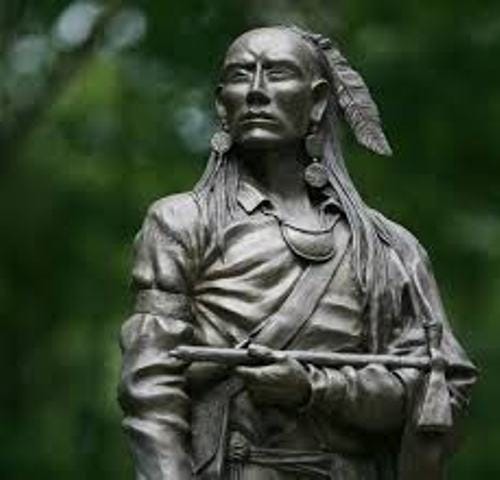
But Tecumseh could not be everywhere at once: he was but the chief of a broken tribe, and when he was not present his feckless fellow-countrymen were all too prone to melt away homeward with their plunder, to fall to the fire-water and remain in a state of hopeless intoxication for days on end, or to disappear after a slight reverse, or the refusal of some preposterous petition.
The real use of the Indians to Brock was mainly that their presence in the woods, and the knowledge of the atrocities of which they were capable, made the Americans very loth to move save in large parties, hindered all scouting by the invaders, and made them very cautious and circumspect. The terror caused by the lurking red man was a more useful asset to the British than his actual achievements in the field. If Brock once or twice had 500 or 600 Indians in his camp, it was quite as common for him to find that they had mostly disappeared when they were specially wanted, and that only the trusty Tecumseh and some few scores remained available.
To obtain a deluxe leatherbound edition of STUDIES ON THE NAPOLEONIC WARS, subscribe to Castalia History.
