

6.6. The English Longbow at Creçy
The longbow had as yet been employed only in offensive warfare, and against an enemy inferior in cavalry to the English army. When, however, Edward III led his invading force into France, the conditions of war were entirely changed. The French were invariably superior in the numbers of their horsemen, and the tactics of the archer had to be adapted to the defensive. He was soon to find that the charging squadron presented as good a mark for his shaft as the stationary column of infantry. Nothing indeed could be more discomposing to a body of cavalry than a flight of arrows: not only did it lay low a certain proportion of the riders, but it caused such disorder by setting the wounded horses plunging and rearing among their fellows, that it was most effective in checking the impetus of the onset. As the distance grew shorter and the range more easy, the wounds to horse and man became more numerous: the disorder increased, the pace continued to slacken, and at last a limit was reached, beyond which the squadron could not pass. To force a line of long-bowmen by a mere front attack was a task almost as hopeless for cavalry as the breaking of a modern square. This, however, was a fact which the continental world had yet to learn in the year 1346.
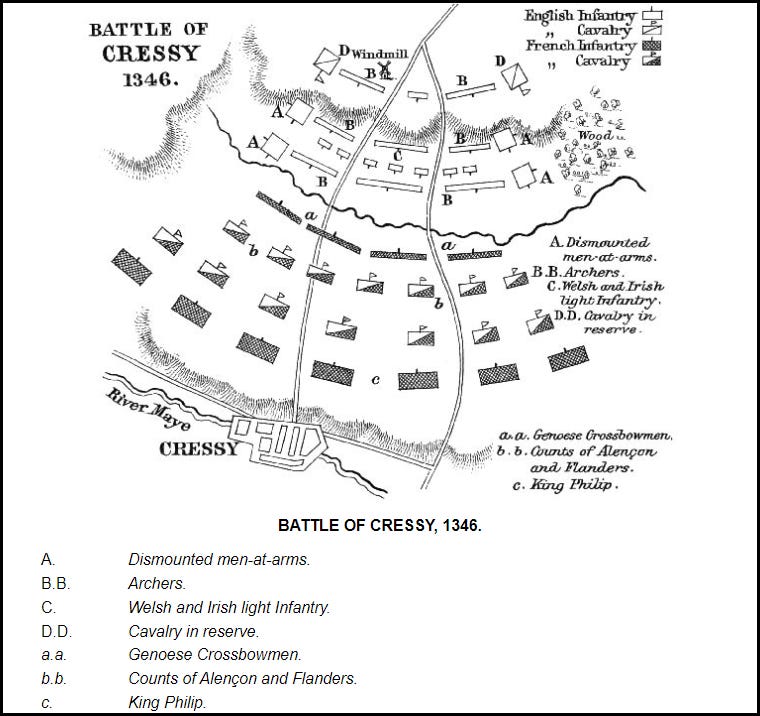
The scientific method of receiving a charge of horsemen by archers flanked with supporting troops was first practised by Edward III at Creçy. When he determined to fight, he chose an excellent position on the gentle slope of a hill, whose flanks were protected by woods and a little brook, which also ran along the front of the line. Following the immemorial usage of the middle ages, the army was drawn up in three ‘battles’, of which the foremost was commanded by the Prince of Wales, the second by the Earl of Northampton, and the third by the King himself. In the front ‘battle’, on which the greater part of the fighting was to fall, 2000 archers were flanked by two bodies of 800 dismounted men-at-arms, who stood in solid phalanx with their lances before them, to receive cavalry charges directed against the wings of the archers. The second line was formed in similar order, while between the two were ranged 1000 Welsh and Cornish light infantry armed with javelins and long knives. The reserve of 2000 archers and 700 mounted men occupied the summit of the hill.
To obtain a deluxe leatherbound edition of THE ART OF WAR IN THE MIDDLE AGES by Sir Charles Oman, subscribe to Castalia History.
For questions about subscription status and billings: subs@castalialibrary.com
For questions about shipping and missing books: castaliashipping@gmail.com
You can now follow Castalia Library on Instagram as well.

As an Eastern European I read Mr. Oman as the voice of the certain historical period.
I.O.W. he seems to be not aware about inferiority of French organisation. Only dumb Frogs for 100 years were unable to comprehend that charging head-on a prepared defensive position was not a proper decision.