

5.14. The Battle of Morat
In the second great defeat which he suffered at the hands of the Confederates the duke was guilty of far more flagrant faults in his generalship. His army was divided into three parts, which in the event of a flank attack could bring each other no succour. The position which he had chosen and fortified for the covering of his siege-operations, only protected them against an assault from the south-east. Still more strange was it that the Burgundian light troops were held back so close to the main-body, that the duke had no accurate knowledge of the movements of his enemies till they appeared in front of his lines. It was thus possible for the Confederate army to march, under cover of the Wood of Morat, right across the front of the two corps which virtually composed the centre and left of Charles’ array. As it was well known that the enemy were in the immediate vicinity, it is hard to conceive how the duke could be content to wait in battle-order for six hours, without sending out troops to obtain information. It is nevertheless certain that when the Swiss did not show themselves, he sent back his main-body to camp, and left the carefully entrenched position in the charge of a few thousand men.
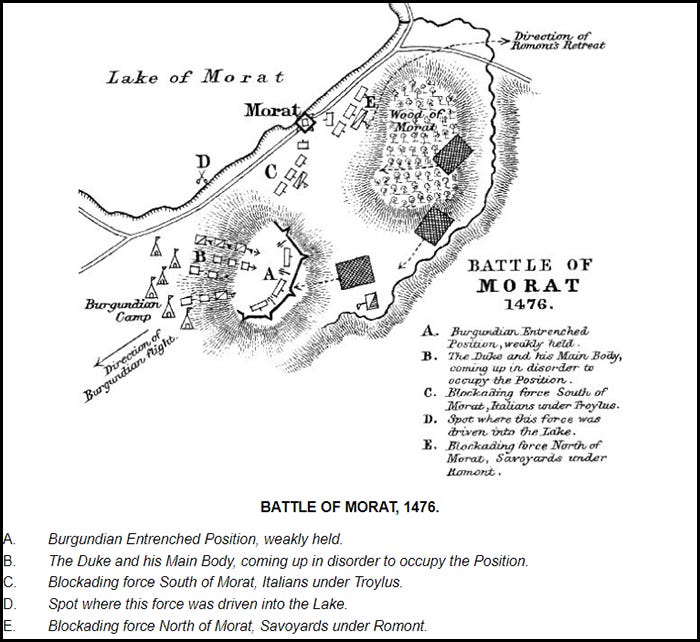
Hardly had this fault been committed, when the Confederate vanguard appeared on the outskirts of the Wood of Morat, and marched straight on the palisade. The utterly inadequate garrison made a bold endeavour to hold their ground, but in a few minutes were driven down the reverse slope of the hill, into the arms of the troops who were coming up in hot haste from the camp to their succour. The Swiss following hard in their rear pushed the disordered mass before them, and crushed in detail each supporting corps as it straggled up to attack them. The greater part of the Burgundian infantry turned and fled, with far more excuse than at Granson.
Many of the cavalry corps endeavoured to change the fortune of the day by desperate but isolated charges, in which they met the usual fate of those who endeavoured to break a Swiss phalanx. The fighting, however, was soon at an end, and mere slaughter took its place. While the van and main body of the Confederates followed the flying crowd who made off in the direction of Avenches, the rear came down on the Italian infantry, who had formed the besieging force south of the town of Morat. These unfortunates, whose retreat was cut off by the direction which the flight of the main-body had taken, were trodden under foot or pushed into the lake by the impact of the Swiss column, and entirely annihilated, scarcely a single man escaping out of a force of six thousand.
The Savoyard corps, under Romont, who had composed the duke’s extreme left, and were posted to the north of Morat, escaped by a hazardous march which took them round the rear of the Confederates.
Though Charles had done his best to prepare a victory for his enemies by the faultiness of his dispositions, the management of the Swiss army at Morat was the cause of the completeness of his overthrow. A successful attack on the Burgundian right would cut off the retreat of the two isolated corps which composed the duke’s centre and left; the Confederate leaders therefore determined to assault this point, although to reach it they had to march straight across their opponent’s front. Favoured by his astonishing oversight in leaving their march unobserved, they were able to surprise him, and destroy his army in detail, before it could manage to form even a rudimentary line of battle.
To obtain a deluxe leatherbound edition of THE ART OF WAR IN THE MIDDLE AGES by Sir Charles Oman, subscribe to Castalia History.
For questions about subscription status and billings: subs@castalialibrary.com
For questions about shipping and missing books: castaliashipping@gmail.com
You can now follow Castalia Library on Instagram as well.
