



NEW RELEASES
Alberte: The Little Duchess 2 by Zénaïde Fleuriot
The little duchess is now the most sought-after young woman in Paris
Alberte de la Rochefaucon is twenty now: beautiful, high-spirited, and the ward of an old ducal name. The wild child of The Little Duchess has become one of the most admired young women in the capital, and the fashionable world has decided her future for her. Her sister Madeleine. the marchioness de Valroux, is determined to see her make a brilliant match, and a dazzling candidate has appeared: David Louzéma, a fabulously rich friend from her Cannes childhood, who sweeps back into her life amid charity bazaars, skating parties, and masked balls, resplendent one evening in the pearls and emeralds of a rajah’s costume.
But Alberte measures men by a different standard. She will give her heart only to someone in whom she can find “a God, a country, and a heart” which draws her not to the glittering foreigner but to Roger de Châteaugrand, a plain young officer of dragoons with little to offerher but faith, honor, and steadiness. Against her stands a formidable alliance: her scheming sister, a severe great-aunt, and a false friend of doubtful reputation, all determined to steer her toward fortune and away from love. What follows is a season-long contest between worldly ambition and quiet conviction, fought out in Second Empire drawing rooms with wit, feeling, and no small amount of intrigue.
The sequel to The Little Duchess, Alberte carries Zénaïde Fleuriot’s most charming heroine into womanhood and the marriage market, and sets her sincerity against the vanities of fashionable Paris. One of the most widely read French novelists of the nineteenth century, Fleuriot wrote the domestic moral novel with a sharp social eye and a deep tenderness for characters who choose substance over show.
This is the first-ever English translation, by Summer Charrette.

Excerpt
“Who are you writing to, Alberte?”
“To my aunt de Châteaugrand, Madeleine.”
Mme de Valroux, who had come to pay her sister a morning call in her dressing-gown and whose face bore the marks of the previous evening’s fatigue, assumed a look of displeasure.
“Is it the letter Roger gave you last night that you are answering?” she said.
“Yes.”
“You are not hard to please. Was there ever such a thing — delivering letters in the middle of a fête? He might at least have disguised himself as a postman.”
“Roger is going to see his mother, who is waiting for my reply.”
“He would do well to go and recover himself a little in the country. The chanoinesse found him horribly changed. For my part, I barely saw him, and it seems he did not dance. But there is nothing astonishing in that — the Châteaugrands have such a character!”
She paused and resumed: “Will you join us later?”
“Good heavens, where are you going later?”
“To visit Chantilly. Your friends the Louzémas don’t know Chantilly — it is a disgrace; and so much has been said to them about it that they have decided on the excursion at once.”
“They will make it without me,” said Alberte.
“What! You won’t come and show them Chantilly?”
“No indeed, the ball lasted until two o’clock, and this evening we have the duchesse de Craonville’s fête.”
“What does that signify? On carnival days one arranges to enjoy oneself twice over.”
“Not I,” said Alberte; “I have not the constitution to bear so many late nights and so many fêtes.”
“You!” cried Mme de Valroux. “It is all very well for you to complain of fatigue, when I put up with it.”
Alberte looked at her sister and replied with a faint irony: “Ah, Madeleine, you have a constitution all your own. You are positively unwell only during Lent and in the country, where you are, in a word, bored.”
“Why, certainly, and I am astonished to hear you complain, you who are never bored anywhere.”
“I have no wish to do anything excessive.”
“And I — it is the excessive that amuses me.”
“Go to Chantilly, then; I shall rest.”
“It is absurd. The Louzémas will be offended.”
“Let them be offended.”
Mme de Valroux looked steadily at her sister.
“Are you speaking sincerely?” she asked.
“You know, Madeleine, that it is my habit.”
“You don’t love your friend more than that?”
It was Alberte’s turn to look at Madeleine.
“Does affection consist in wearing oneself out over frivolities for those one loves?”
“It consists in following them, not in separating from them. I find you shockingly ungrateful toward Luna and her brother.”
“Her brother?” Alberte replied, with a touch of pride. “What obligations have I contracted toward her brother?”
“What! Why, he is at your feet! At a sign from you, carriages, servants are at my disposal. You know you have something to do with their installing themselves on the Avenue des Champs-Élysées. You had only to say you could not understand living at a hotel for him to leave the Continental.”
“Enough,” said Alberte; “I know he commits enough follies of that kind, but I am sometimes more put out than charmed by them.”
“Why?”
“Because it has the air of binding me. And I make it a point of honour to tell you, I still see a difference between Roger de Châteaugrand and David Louzéma.”
“A difference there is, only not in the sense you would like to believe. No one thinks as you do. Good heavens! how can one compare these two men as matches? With Roger, you will be, for all your birth, nothing but a common officer’s wife, following him from garrison to garrison, obliged to see and to visit people you would never have dreamed of associating with, who will be your superiors, and who may subject you to a thousand slights without your being able to complain. With an army composed as ours is, there is no longer any possibility of our marrying officers on active duty — servants of the most ridiculous of governments.”
Alberte raised her head sharply.
“Roger serves only France,” she said; “and it will always be a very noble thing to serve France.”
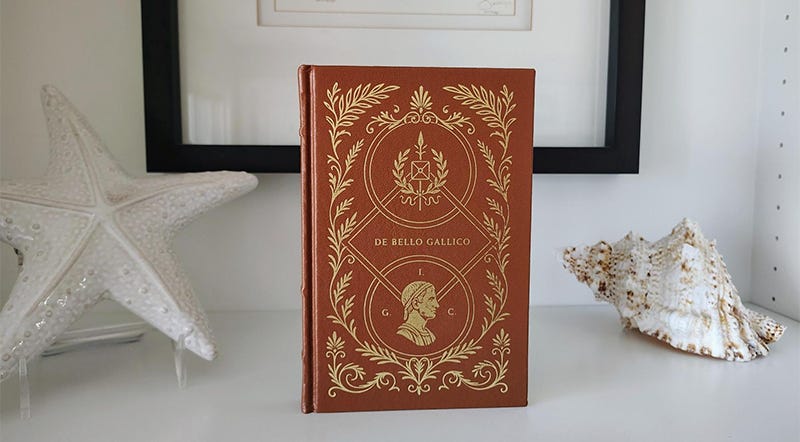
Castalia Library makes the world’s most beautiful leather books at its own bindery in Switzerland. Castalia House is the premier translator of never-before translated works from Japanese, Spanish, French, Italian, and German into English. To support Castalia House’s historic translation efforts and receive a new translated ebook every week, support the Alexandria project, and get future access to Castalia Unlimited, become a paid subscriber to this substack. And to receive a premium deluxe leatherbound book every three months, subscribe to Castalia Library.
Ouch! I see these are no longer part of Kindle Unlimited, and priced at $5, which is $2 above my impulse buy price. I just bought Suicidal Empathy instead, at its temporary sale price of $3. Here's hoping you'll participate in Hans G. Schantz's occasional Based book sales, offering Ebooks for a week either free or for $1 to introduce readers to good authors the big publishers shun.