


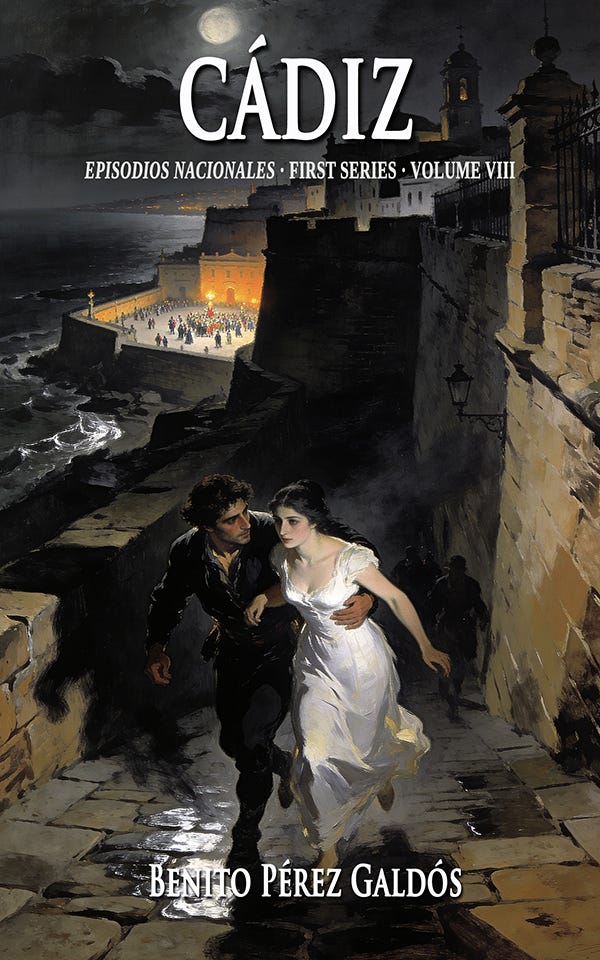
CÁDIZ by Benito Pérez Galdós is this week’s new translation. It is the eighth of the first series of the Episodios Nacionales and was translated from the original Spanish by Vox Day. The ebooks have already gone out to the subscribers. It’s now available on Amazon for Kindle, KU, and audiobook.
AN UNEXPECTED RIVAL
The eighth volume of the Episodios Nacionales — the great historical novel cycle of Spain — Cádiz carries Gabriel Araceli into the besieged island city where Spain’s first constitution is being born, and where a drawing-room intrigue will end in blood on the sand.
It is 1810, and Cádiz is the last free city in Spain. While French cannon fire arcs across the bay and the newly convened Cortes debates sovereignty, freedom of the press, and the abolition of feudal lordships, Gabriel finds himself entangled in a world of tertulias and domestic politics more dangerous than any battlefield. The condesa Amaranta needs his help to recover her secret daughter, Inés, from the household of the formidable doña María de Rumblar — a Catholic absolutist matriarch who has imprisoned the girl behind the walls of a household so rigidly governed it resembles a convent. To reach Inés, Gabriel must navigate a social minefield: the effusive doña Flora, whose speeches are torrents of self-interruption and genuine warmth; the feckless young Count Don Diego, who is supposed to marry Inés for family advantage; and the absurd Don Pedro del Congosto, commander of a militia so magnificently incompetent that its members are named after parrots and peacocks.
At the centre of everything is Lord Gray, a brilliant, melancholic Englishman who delivers dazzling speeches against his own country, joins the beggars at the Carmen convent for the philosophical experience, and quotes Byron while systematically destroying the people around him. Gabriel believes Lord Gray is pursuing Inés. He is wrong. The truth, when it comes, is worse than anything Gabriel has imagined.
About the Series
The Episodios Nacionales is a cycle of forty-six historical novels tracing the history of Spain from the Battle of Trafalgar in 1805 through the Restoration of the 1870s. Written between 1872 and 1912, the cycle is one of the supreme achievements of European fiction, a work that stands with Balzac’s Comédie Humaine as a panoramic portrait of an entire nation across a century of upheaval. This is the first English translation of the eighth volume.
About the author. Benito Pérez Galdós (1843–1920) is widely regarded as the greatest Spanish novelist since Cervantes. Over four decades, he produced the Episodios Nacionales, one of the most incredible accomplishments of world literature ever written. He was nominated for the Nobel Prize in Literature five times.
Excerpt
We arrived at the house, which stood in the calle de la Amargura and was handsome in appearance. The De Leiva family lived on the upper floor and the Rumblars on the principal, where doña María, owing to the recent rheumatism of her illustrious kinswoman, exercised the office of supreme chief and director of the family with all the amplitude that her character demanded. As we entered and began to climb, a distant, solemn murmur of prayers checked our steps, and Don Diego said:
“Let us wait here; they are saying the rosary with Ostolaza, Tenreyro, and Don Paco. You already know the last of these. The others are deputies who come here every evening.”
While we waited I observed the house, which was cheerful and pretty like all the houses of Cádiz. Spacious glass doors enclosed the corridor around the courtyard, and on the walls one could not see a palm’s breadth of surface unoccupied by paintings in oil, representing diverse subjects, the sacred confounded indiscriminately with the profane. At length, the prayers concluded, I had the honour of entering the drawing room, where doña María sat with her two girls, Don Paco, and three other gentlemen unknown to me. The condesa de Rumblar received me with a certain ceremonious courtesy, somewhat stiff but nonetheless affable, showing me a benevolence that descended from on high, generous and compassionate by turns. The girls, observing the ritual to which they were accustomed, made me a curtsey without parting their lips. Don Paco, as pedantic in Cádiz as he had been in Bailén, paid me grandiloquent compliments, and the remaining personages regarded me with suspicious reserve, showing me no civility beyond a few rigid inclinations of the head.
“You have arrived late for the rosary,” said doña María to Don Diego, after indicating a seat to me.
“But did I not tell you,” the young man replied, “that I was saying it this afternoon at the Carmen Calzado? I have just come from there, together with Gabriel, who was returning from confession with Father Pedro Advíncula.”
“What an excellent man Father Pedro Advíncula is!” doña María said to me in a tone of the highest commendation.
“There is not his equal in all Cádiz,” I replied, “especially in the matter of the confessional. And in the pulpit! And who could surpass him at singing an epistle?”
“It is true.”
“I am captivated to hear him sing the epistle,” Don Diego repeated.
“I am delighted,” doña María said to me, “by the great advances you have made in your career.”
I bowed before the matron with the profoundest respect.
“Every person of rectitude and honour, devoted to the good service of religion and the king,” she continued, “cannot fail to find a reward for his labours. I much regretted that my son did not remain in the army somewhat longer.”
“Gabriel and I worked hard enough at the bridge of Herrumblar,” said Don Diego. “In truth, dear mother, had it not been for us… The fact is we made a movement with our squadron in such terms that… do you remember, Gabriel? Frankly, had it not been for us…”
“Hold your tongue, vainglorious boy,” said doña María. “This gentleman has done more than you and does not boast of it. Self-praise is a low and ignoble thing, unworthy of persons well born. Will Señor Don Gabriel be staying long in Cádiz?”
“Until the siege is over, Señora. After that I intend to lay down my arms and pursue my burning vocation, which impels me toward a career in the Church.”
“I praise your resolution greatly, and there are illustrious saints in heaven who were first valiant soldiers, such as Saint Ignatius of Loyola, Saint Sebastian, Saint Ferdinand, Saint Louis, and others.”
“Have you studied theology?” one of the gentlemen present asked me.
“My campaign valise contains nothing but works of theology, and whenever I find a moment’s leisure between one battle and the next, I gorge myself on reading in a subject which to me is more delightful than the finest novels. The melancholy hours of guard duty afford me space and time for my meditations.”
“Asunción, Presentación,” said doña María with enthusiasm, “here you have an example that should astonish and inspire you.”
Asunción and Presentación, hearing that I was a species of saint, regarded me with wide-eyed wonder. I looked at them in return. They were so pretty, prettier even than at Bailén; yet crushed beneath the exaggerated weight of maternal authority, their beautiful eyes were full of sadness. Without their mother noticing, they exchanged a few words in whispers.
The Castalia House Translation Subscription
Sanshirō by Natsume Sōseki
Botchan by Natsume Sōseki
Kokoro by Natsume Sōseki
The Kamigata Scroll by Eiji Yoshikawa
The Edo Scroll by Eiji Yoshikawa
The Kiso Scroll by Eiji Yoshikawa
The Funaji Scroll by Eiji Yoshikawa
The Tsurugisan Scroll by Eiji Yoshikawa
The Naruto Scroll by Eiji Yoshikawa
Trafalgar by Benito Pérez Galdós
The Court of Carlos IV by Benito Pérez Galdós
The Nineteenth of March and the Second of May by Benito Pérez Galdós
Bailén by Benito Pérez Galdós
Napoleon at Chamartín by Benito Pérez Galdós
The Gold Demon by Kōyō Ozaki
The Casebook of Hanshichi Volume I: The Ghost Master by Kidō Okamoto
The Casebook of Hanshichi Volume II: The Cat Commotion by Kidō Okamoto
The Little Duchess by Zénaïde Fleuriot
Zaragoza by Benito Pérez Galdós
Sans Beauty by Zénaïde Fleuriot
Gerona by Benito Pérez Galdós
Cádiz by Benito Pérez Galdós
To support Castalia House’s historic translation efforts and receive a translated ebook every week, become a paid subscriber to this substack. To receive a deluxe leatherbound book every three months, subscribe to Castalia Library.