



NEW RELEASES
Kojiki: The Record of Ancient Matters by O no Yasumaro
Romance of the Three Kingdoms Vol. 4: The Way of the Vassal by Eiji Yoshikawa
BEFORE THERE WAS JAPAN, THERE WAS CHAOS
From the first stirring of heaven and earth, through the quarrel that split the sun goddess and the storm god and plunged the world into darkness, to the divine ancestors who descended from the heavens to rule the islands, the Kojiki is where the story of Japan begins.
Compiled in 712 Anno Domini by the court scholar Ō no Yasumaro from the oral recitation of Hieda no Are, the Kojiki is the oldest surviving book in Japan and the foundational text of Japanese civilization. It moves from the raw, strange power of creation mythology, where gods die giving birth to fire and descend into the underworld to retrieve the dead, through the Age of the Gods and the establishment of the imperial line, into the semi-historical reigns of the early emperors and empresses of Japan. Along the way it preserves some of the oldest poetry in the Japanese language: love songs, war songs, laments, and riddles that were already ancient when they were first written down.
This is not the Kojiki of the classroom. This translation by Kenji Weaver renders Japan’s origin story as what it was always meant to be: a work of literature, told with the gravity and sweep its subject demands. The gods behave like true pagan gods, passionate, jealous, magnificent, and terrifying. The emperors consolidate their power through marriage, war, and guile. Now available on Amazon.

Excerpt
Prince Itsuse
Setting forth from that land, they passed through the bay of Naniwa and moored their vessels at the harbor of Shirakate in Kawachi. At that time Nagasunehiko, who dwelt at Tomi in Yamato, raised an army and stood waiting to give battle. They took the shields stored aboard the vessel and went ashore. That place came to be called Tatetsu, the Shield Harbor. It is called Tatetsu of Kusaka to this day.
In the battle against Nagasunehiko, Itsuse no Mikoto took an arrow wound to his hand. He said, “It is not fitting that I, a child of the Sun, should fight facing the sun. That is why I have suffered a wound from so base an enemy. Let us circle round and strike with the sun at our backs.” They turned southward, and when they reached the sea of Chinu in the province of Izumi, he washed the blood from his hand. From this the sea takes the name Chinu.
They continued onward and came to the harbor of Wo in the province of Kii. There Itsuse no Mikoto cried out, “That I should die of a wound dealt by so base an enemy!” and perished. His tomb stands at Kamayama in Kii.
From Kumano to Yamato
Kamuyamatoiwarehiko no Mikoto pressed on and came to Kumano. There a great bear appeared dimly before him and vanished. At once Kamuyamatoiwarehiko no Mikoto lost consciousness, and all his soldiers likewise fell senseless to the ground.
At this time a man of Kumano named Takakuraji came bearing a great sword to where the divine child of heaven lay stricken, and presented it to him. Kamuyamatoiwarehiko no Mikoto awoke and said, “How long I have slept.” When he received the sword, the malevolent gods of the mountains of Kumano were cut down of their own accord, and the stricken army revived to a man.
The divine child of heaven asked how Takakuraji had come by the sword. Takakuraji replied: “In my dream, Amaterasu Ōmikami and Takagi no Kami gave a command to Takemikazuchi no Kami: the Central Land of the Reed Plain is in great turmoil; our children are in distress; that land was yours to pacify, so go down to it once more. Takemikazuchi no Kami answered that he need not descend himself; the sword with which he had pacified that land still remained, and he would send it down. He would open a hole in the roof of Takakuraji’s storehouse and drop it through. Then the gods instructed me: when you wake at dawn, take this sword and present it to the divine child of heaven. I woke and looked into my storehouse, and the sword was truly there. That is why I bring it now.”
This sword is called Sajifutsu no Kami, also known as Mikafutsu no Kami, and also as Futsunomitama. It rests today at the Isonokami Shrine.
Then came a command from Takagi no Kami: “Divine child of heaven, advance no further into this land. Many malevolent gods dwell within. I shall send the Yatagarasu from heaven. The Yatagarasu shall guide you; follow where it leads.”
Following the Yatagarasu as instructed, they came to the lower reaches of the Yoshino River. There a man was catching fish with a trap set in the river. The divine child of heaven asked, “Who are you?” He answered, “I am a god of this land. My name is Nihemotsu no Ko.” He is the ancestor of the cormorant fishers of Ada.
Going on from there, a man with a tail emerged from a well. The well was luminous. “Who are you?” asked the divine child of heaven. “I am a god of this land. My name is Ihika,” he replied. He is the ancestor of the Yoshino no Obito.
Pressing into the mountains, they met another man with a tail, who came pushing through the rocks. “Who are you?” asked the divine child of heaven. “I am a god of this land. My name is Iwaoshiwaku. I heard that the divine child of heaven had come, and so I came forth to meet him.” He is the ancestor of the Kuzu of Yoshino.
From there they crossed the mountains, treading a path through to Uda. This is why it is called Ugachi of Uda.
WHO ARE THE HEROES OF THE AGE?
Lü Bu makes his last stand at the White Gate Tower. The Emperor writes a secret edict in his own blood. And in a moonlit garden, over warm wine and green plums, Cao Cao asks Liu Bei the most dangerous question in the world: “Who are the heroes of this age?”
Volume Four of Yoshikawa Eiji’s epic adaptation of the great Chinese classic, the Romance of the Three Kingdoms, plunges into the treacherous heart of the late Han, where every alliance is a gamble and every banquet may be a trap. Cao Cao tightens his grip on the imperial court while Liu Bei tends his garden and bides his time, knowing that a single misstep will cost him everything. Meanwhile, the blood oath sworn at the Peach Garden faces its greatest test as Guan Yu is separated from his brothers and must choose between loyalty and survival.
From the fall of Lü Bu to the desperate ride north, The Way of the Vassal chronicles the education of men who would be kings in the arts of patience, sacrifice, and knowing the right moment to strike. This is the volume where the game changes and the warlords of the Three Kingdoms begin to understand that the realm will not be won by the sword alone.
This is the first complete and unabridged English translation of Yoshikawa’s Sangokushi, the novel that defined the Three Kingdoms chronicle for modern readers across Asia. Translated from the Japanese by Vox Day. Now available on Amazon.

Excerpt
The storm of the purge had passed. The blood had been cleaned from the streets. A rank wind swept through the capital and was gone, and those who breathed easiest afterward were not Cao Cao and his men but the common people.
Cao Cao wore the face of a man for whom nothing had happened. In his breast there remained neither the bitterness nor the bile of yesterday. His mind was already absorbed in a hundred schemes for tomorrow.
“Xun Yu.” He spoke as though beginning a matter of routine. “There are still names unaccounted for. And not minor ones.”
“Ma Teng in the west, and Xuande in Xu Province.”
“Precisely. Both signed the oath of Dong Cheng’s loyalist pact. Both have demonstrated their treasonous intent beyond any shadow of doubt. Something must be done.”
“That goes without saying.”
“Then let me hear your strategy.”
“The provincial troops of Xiliang have always been fierce. We cannot engage them lightly. Xuande, for his part, holds the strategic heart of Xu Province, with Xiapi and Xiaopei fortified in the Horns of the Bull formation. His forces are small, but I do not think he can be subdued quickly.”
“If we approach every enemy with that degree of caution, then every enemy will prove formidable and we shall never move against any of them.”
“Were there no Yuan Shao in the north, I would have no reservations. But his border forces at Guandu have been steadily reinforced of late. Your Excellency’s true adversary is Yuan Shao, and no other. He is the one who contends with you for mastery of the empire.”
“Which is exactly why I wish to strike at Xuande first. He is Yuan Shao’s right hand in the south.”
“No, no. We cannot strip the capital of its defenses at such a time. Better to lure Ma Teng here with honeyed words, dispose of him by deception, and then apply diplomatic pressure to Xuande at our leisure, blunting his resolve while spreading false reports to sow distrust between him and Yuan Shao. That, I believe, is the surest course.”
“Too slow. A plan that moves too slowly becomes a different plan. While we sit deliberating, the situation around us shifts, and then we find ourselves revising our strategy in the middle of its execution. That is the lowest grade of generalship.”
Cao Cao’s determination to strike Xuande first was not entirely a matter of strategy. He had once lavished affection on the man, had embraced him as a friend and near equal, and the violence of that earlier attachment now rebounded as its opposite. It was Cao Cao’s particular failing that even in questions of the gravest national consequence, he could never entirely separate calculation from feeling.
The two men were debating behind closed doors when Guo Jia entered the chamber. Guo Jia was another of the advisors Cao Cao trusted most within his inner council.
“You arrive at the right moment. What is your view?”
Guo Jia answered without hesitation.
“There is no question. We must crush Xuande in a single stroke. He has governed Xu Province too briefly to command the people’s loyalty; his roots there are shallow. As for Yuan Shao, his bluster is loud but his house is divided. Tian Feng, Shen Pei, Xu You, all of them fine officers, and not one of them can agree with the others. Add to that Yuan Shao’s own chronic indecision. How could such a man launch a swift campaign? He will not move.”
The argument aligned perfectly with Cao Cao’s own desire. He decided on the spot. Summoning his chief of military affairs, his staff officers, his divisional commanders, and the directors of supply and transport to a single hall, he issued his orders.
“Muster two hundred thousand troops. Divide them into five divisions. Advance on Xu Province by three routes.”
The armies moved at once. And almost as quickly, word of the mobilization spread south to Xu Province.
The first to catch wind of it was Sun Qian. He raced to Xiapi to alert Guan Yu, then without pausing rode hard for Xiaopei.
Liu Bei was at Xiaopei. The news struck him like a blow.
“The blood edict discovered. The Imperial Uncle Dong and all who stood with him, dead. I had steeled myself for the possibility, and yet...”
“My lord, you must write to Yuan Shao at once. I will carry the letter myself and beg for his aid. There is no other course.”
Sun Qian took Liu Bei’s letter, mounted a fresh horse, and rode north through the night without rest, pressing toward Hebei as though the darkness itself were at his heels.
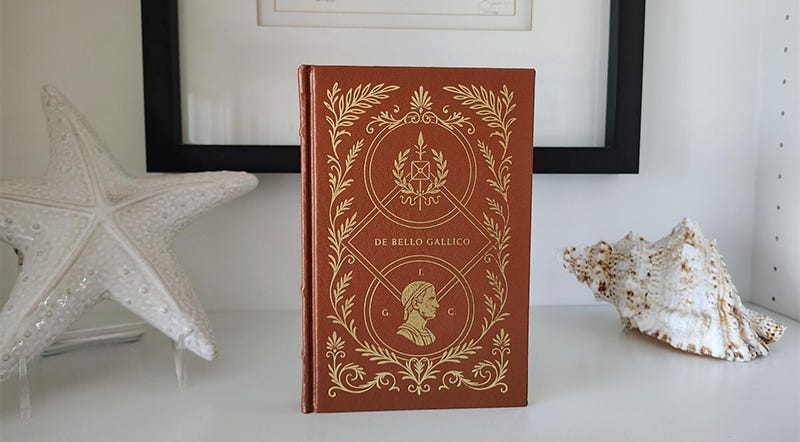
Castalia Library makes the world’s most beautiful leather books at its own bindery in Switzerland. Castalia House is the premier translator of never-before translated works from Japanese, Spanish, French, Italian, and German into English. To support Castalia House’s historic translation efforts and receive a new translated ebook every week, support the Alexandria project, and get future access to Castalia Unlimited, become a paid subscriber to this substack. And to receive a premium deluxe leatherbound book every three months, subscribe to Castalia Library.