


NEW RELEASE
Romance of the Three Kingdoms Vol. 7: One Gazes Toward Shu by Eiji Yoshikawa
THE BITTER ASHES OF DEFEAT
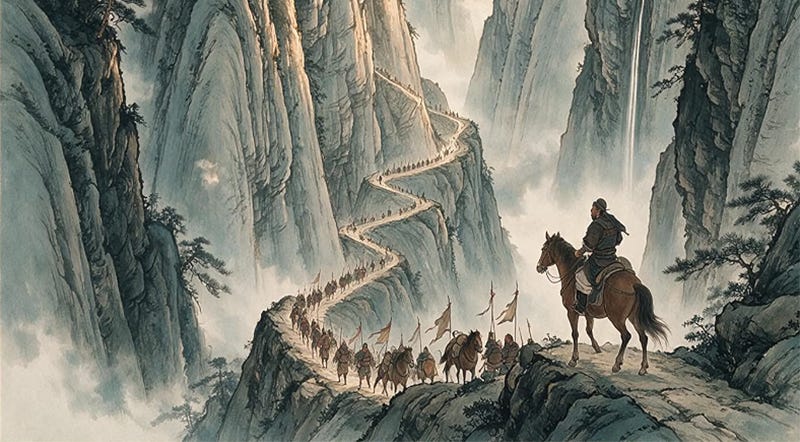
The river burned and the man who thought he could not lose saw his budding empire go up in flames. In a single night, the Battle of Red Cliffs broke Cao Cao’s southern ambitions in a single night, and nothing that follows his defeat will resemble what came before.
But the destruction of his thousand-ship fleet is only the beginning of the end. In the chaos of Cao Cao’s retreat, the Dragon, no longer sleeping, orchestrates a pursuit so precisely timed that it feels less like war and more like music, with each general positioned at the exact place where the fleeing army must pass, and each ambush sprung at the moment of maximum exhaustion. Only one trap is left deliberately empty, and the reason why reveals more about Kongming’s long game than any of his stunning victories could.
Volume Seven of Yoshikawa Eiji’s epic follows the aftermath of the war as it reshapes the map. Zhou Yu, the man who lit the fire at Red Cliffs, discovers that his greatest rival is not Cao Cao but the ally sitting in his own camp. Liu Bei has finally gathered land, an army, and a general, and the road to Shu now lies open before him. The age of the three kingdoms is no longer a dream. It is a fact on the ground, and every man who helped create it is already calculating how to best take advantage of what inevitably comes next.
This is the seventh book in the first complete and unabridged English translation of Yoshikawa’s Sangokushi, the novel that defined the Three Kingdoms classic for modern readers across Asia. An original Castalia House translation.

Excerpt
Of all the men who had grounds for restlessness, none suffered more keenly than Zhang Fei. Day after day he stood at Xuande’s and Kongming’s side, resplendent in his brocade armor, reduced to the role of an ornamental lord in a ceremonial line. It was not a role for which nature had fitted him.
“Zhao Yun has already taken Guiyang and earned himself a commendation. Am I, his senior in years and service, to be left here yawning while others reap the harvest?”
He pressed Kongming with pointed insinuation, angling, none too subtly, for the next assignment: the assault on Wuling.
“And if you should meet with some misfortune on the field?”
Kongming put the question as though genuinely concerned, probing for the commitment he knew would follow.
“Then take my head under military law and make of it an example for all who come after.”
Zhang Fei dashed off a written pledge and thrust it forward with furious indignation.
“Then go,” said Xuande, and gave him three thousand men.
Zhang Fei leapt into the saddle with a roar of delight and rode hard for Wuling.
Within the city, one of the garrison commanders, a man named Gong Zhi, was already counseling the Prefect Jin Xuan.
“The name and benevolence of Liu Xuande, Imperial Uncle of the Great Han, have already reached these parts. Zhang Fei is a tiger among generals, famed throughout the realm. To resist such a force would be folly.”
“Traitor! So you have been in secret communication with the enemy.”
Jin Xuan flew into a rage and would have taken Gong Zhi’s head on the spot. Others intervened and saved the man’s life, but Jin Xuan himself lost no time in marshaling his forces, deploying a defensive line twenty li beyond the walls.
Zhang Fei’s method of warfare was blunt-force assault at the gallop, nothing more. Against such violence, a commander as unimaginative as Jin Xuan stood no chance. He was scattered and routed and came fleeing back toward his own gates.
There, from the tower above the gatehouse, Gong Zhi stood with bow drawn and arrow nocked.
“The people of the city have rallied to my counsel. The decision to surrender to Xuande has already been made!”
The bowstring sang. The arrow struck Jin Xuan full in the face.
Gong Zhi took the head, threw open the gates, and welcomed Zhang Fei into the city, declaring that he had long admired Xuande and wished for nothing more than to serve under his banner.
Zhang Fei posted the military ordinances, restored calm among the populace, and dispatched Gong Zhi with a letter to Xuande at Guiyang, bearing a full account of the victory.
Xuande appointed Gong Zhi Prefect of Wuling. With three commanderies now secured, he sent word to Guan Yu at Jingzhou so that his brother might share in the triumph.
A reply came at once. Zhang Fei and Zhao Yun had each won distinction, Guan Yu wrote, and he confessed he envied them bitterly. If only the order to take Changsha might fall to him, he could not begin to express how deeply it would fulfill his ambitions as a soldier. The letter trailed on in this vein, eloquent in its longing, plaintive in its idleness.
Xuande recalled Zhang Fei to Jingzhou to take Guan Yu’s place, then gave Guan Yu a mere five hundred cavalry.
“Take Changsha with these.”
Guan Yu had never measured himself by the size of his forces. He set about his preparations at once. But before he could depart, Kongming drew him aside.
“This may require no warning for a commander of your stature, but in war the first necessity is to know your enemy’s substance. The Prefect of Changsha, Han Xuan, is a man of no account. But one officer has long sustained him, governing Changsha ably these many years. This man is approaching sixty; his hair and beard will be white as frost. Yet on the battlefield he wields a great saber with fearsome skill, draws an iron bow, and possesses the valor of ten thousand men. He is the foremost warrior in all of Hunan: Huang Zhong. You must not take him lightly. If you mean to face such a man, you would do well to ask our lord for three thousand cavalry more. Anything less would be reckless.”
But Guan Yu, for reasons known only to himself, heard Kongming’s counsel and let it pass through him like wind. He requested no reinforcements. That very night, with only his five hundred riders, he was gone.
After his departure, Kongming turned to Xuande.
“Guan Yu still carries the weight of sentiment from the affair at Red Cliffs. If fortune turns against him, Huang Zhong may well be the death of him. And five hundred is far too few. My lord should follow in person with a reserve force, lending quiet support from behind.”
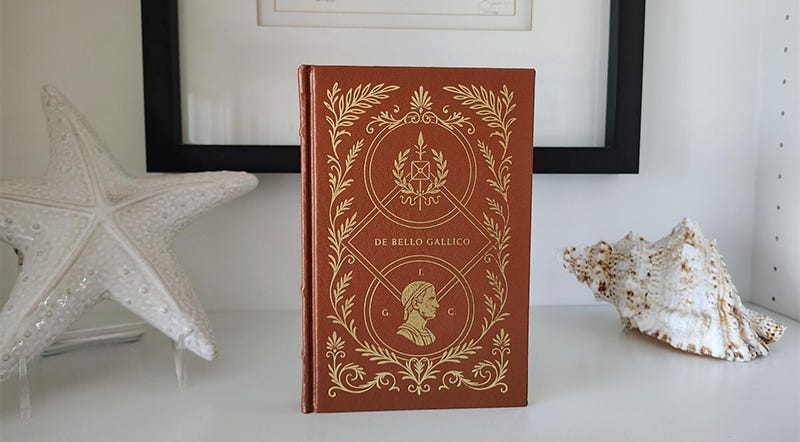
Castalia Library makes the world’s most beautiful leather books at its own bindery in Switzerland. Castalia House is the premier translator of never-before translated works from Japanese, Spanish, French, Italian, and German into English. To support Castalia House’s historic translation efforts and receive a new translated ebook every week, support the Alexandria project, and get future access to Castalia Unlimited, become a paid subscriber to this substack. And to receive a premium deluxe leatherbound book every three months, subscribe to Castalia Library.