



NEW RELEASES
Romance of the Three Kingdoms Vol. 6: Red Cliffs by Eiji Yoshikawa
The Floating Airfield by Juza Unno
THE DRAGON RISES
Cao Cao marches south with eight hundred thousand men. Behind him lies the conquered north. Before him lies the Yangtze, and beyond it the last two powers that stand between him and total dominion. On paper, the war is already over.
But Zhuge Liang has other plans.
Fresh from his mountain hermitage, the Sleeping Dragon makes his first moves on the world stage, and they are breathtaking. Sent alone into the hostile court of Sun Quan to forge an alliance that neither side wants, Kongming stares down a room full of scholars who think he is a youthful fraud and a warlord who has every reason to surrender. What follows is one of the great diplomatic duels in all of literature, a battle fought entirely with words, patience, and the masterful use of a man’s pride against his fear.
The sixth volume of Yoshikawa Eiji’s grand epic builds toward the most famous battle in Asian literature. But Red Cliffs is not only a war story. It is the volume where Kongming reveals what he truly is, where Zhou Yu discovers that the ally he despises may be the only man who can save him, and where the nature of the Yangtze itself is transformed from a geographical barrier into a weapon. The great fire on the river is coming. Everything before it is just the kindling.
This is sixth book in the first complete and unabridged English translation of Yoshikawa’s Sangokushi, the novel that defined the classic Three Kingdoms story across Asia. An original Castalia House translation; the remaining four books will be published this week.

Excerpt
“There is one possibility,” Kongming said, his voice dropping to a whisper.
“The lord of this province, Liu Biao, lies gravely ill. By all reports, his condition has grown critical. Is this not Heaven itself preparing the way? Take Jingzhou on loan and make it the foundation for all that must follow. The territory is broad, the mountain passes are few and easily held, and the military provisions and revenues are more than ample.”
Xuande shook his head.
“It may be a sound plan, but everything I am today I owe to Liu Biao’s generosity. To exploit my benefactor’s mortal illness and seize his domain is something I cannot do.”
“My lord, you must set aside this narrow scruple and live for the greater cause. If you do not take Jingzhou now, the day will come when you look back in regret and find that the moment has passed beyond recall.”
“Even so. To act against human feeling, to betray a bond of trust…”
“And if, while we stand here debating the point, Cao Cao’s great army descends upon us? What then?”
“Whatever calamity may come, I would sooner face it than be called an ungrateful man.”
“Ah.” Kongming’s voice softened. “Truly, my lord is a man of perfect benevolence.”
There was nothing more to be said, no further argument or remonstrance to offer. Kongming fell silent.
Meanwhile, Xiahou Dun had returned to the capital. His boasts had been worth nothing; the defeat was total; he had barely escaped with his life. He bound his own hands and blindfolded himself in the manner of a condemned prisoner, and in this posture of abjection he knelt at the foot of the stairs leading to the Chancellor’s hall.
He had no face left with which to meet anyone. His appearance said everything his voice could not.
Cao Cao came out, took one look at him, and gave a short, sardonic laugh.
“Take that off him,” he said to the attendants, jerking his chin toward the blindfold, and permitted Xiahou Dun to mount the stairs.
Xiahou Dun prostrated himself upon the floor of the hall and, at the Chancellor’s bidding, reported the course of the battle.
“My gravest error was this: I failed to anticipate the enemy’s use of fire, and I led our forces too deep into the ravines and forest beyond Bowang Slope. Countless soldiers of the Chancellor’s army perished because of my folly. My crime warrants death ten thousand times over.”
“You have studied military science since boyhood. You have marched through campaign after campaign, fought on field after field. And yet you could not see that a narrow road is always the ground for a fire attack? How can a man with that blindness presume to command an army?”
“There is nothing I can say in my defense. Yu Jin perceived the danger and warned me, but by then it was already too late.”
“Yu Jin has the judgment of a true general. And you are no born fool. Redeem yourself at the next opportunity and wash away this shame.”
That was all. Cao Cao pressed the matter no further.
PRE-WORLD WAR II JAPANESE MILITARY SCIENCE FICTION
In the South China Sea, the training cruisers Suma and Akashi are on a routine exercise when something impossible appears in the sky — a massive artificial island, flat-topped like a carrier flight deck but vastly larger, hanging silently above the ocean. It should not exist. It cannot fly. And yet it does.
Lieutenant Commander Kawakami, the fleet’s sharpest engineering officer, and Lieutenant Hasebe, his gunnery counterpart, are among the first to witness the apparition. When the training squadron’s investigation draws a lethal response, the two officers find themselves drawn into a escalating confrontation with a technology that rewrites everything the Imperial Navy thought it knew about the limits of the possible.
First published in 1938, The Floating Airfield is military science fiction from the dawn of the genre in Japan — a novel of competent men facing an engineered mystery, written by Unno Juza, the father of Japanese science fiction. Never before translated into English, it stands alongside the best of Piper and early Pournelle: taut, professional, and relentlessly inventive.

Excerpt
No matter how you looked at it, the whole affair was inexplicable.
And that was not the only strange thing.
According to what Lieutenant Hasebe gathered from the enlisted men, every last one of Lieutenant Commander Kawakami’s uniforms was accounted for, hanging in his cabin exactly where they belonged.
Which meant, by simple logic, that the lieutenant commander ought to be walking around stark naked.
Yet Seaman Second Class Sugita, the man who served as Kawakami’s personal attendant, told a different story. He had accompanied the lieutenant commander ashore to the Floating Airfield that afternoon, and Kawakami had been in full naval officer’s dress at the time.
A baffling contradiction. How was anyone supposed to make sense of it?
The training cruiser Akashi carried her mystery into the night.
The enlisted men’s quarters, normally loud with laughter and rough good humor after dark, lay under a pall of uneasy silence.
“Sugita’s still not back,” said Ōtsuji, a heavyset seaman second class, glancing toward the passageway leading to officers’ country.
“Taking his sweet time,” another man agreed. “You don’t think the captain’s got him in a corner, caught up in something he can’t talk his way out of?”
Another sailor shoved his face toward Ōtsuji.
“Hey. Ōtsuji.”
“What do you want, Uozaki?”
“Don’t ‘what’ me. Sugita’s in hot water because you can’t keep your damn mouth shut.”
“Running my mouth? What the hell are you talking about? This Ōtsuji right here has never said one unnecessary word in his life.”
Uozaki and the others burst out laughing. Ōtsuji’s loose tongue was legendary aboard ship. If the man learned something, every sailor on the Akashi knew it ten minutes later.
“Cut the act, Ōtsuji. You’re the one who said it: ‘All of Lieutenant Commander Kawakami’s uniforms are present and accounted for in his cabin, sir, so the lieutenant commander must be stark naked at this very moment, sir.’ Nobody asked you for that last part.”
“Wha—”
Ōtsuji’s eyes bulged.
“Now you listen here, Uozaki. What’s wrong with what I said? It’s the truth, isn’t it? Or are you telling me I should lie to a superior officer? You watch yourself. We may be friends, and never mind how many times you’ve mooched my shiruko, but I won’t stand for that. You’re telling me to lie to a superior? Are you?”
“Nobody’s talking about lying. I’m saying don’t volunteer things nobody asked for. That bit about him being stark naked was the unnecessary part. You think an Imperial Navy man, no matter how hot it gets, is going to walk around buck naked in front of foreigners? It’s a disgrace to the service.”
“Oh, now the argument’s getting slippery. You just realized I had you beat, didn’t you. If every uniform is accounted for, the man’s naked. Stands to reason.”
“Don’t be an idiot. He is absolutely not walking around naked.”
“Who’s the idiot? If a man has no clothes, what else is he going to be?”
“I’ll tell you what. I believe he’s wearing at least a loincloth.”
“A loin-cloth!”
Ōtsuji’s jaw dropped open like a baboon’s.
“You moron!”
“All right, that was a joke. But he could be wearing an undershirt. Or a sleeping robe. There are all kinds of possibilities. But you had to go charging in with ‘Every uniform is present and accounted for, sir, so Lieutenant Commander Kawakami must be stark naked, sir.’ And the reason Sugita still hasn’t come back from the captain’s cabin, when you trace it back, is that big mouth of yours.”
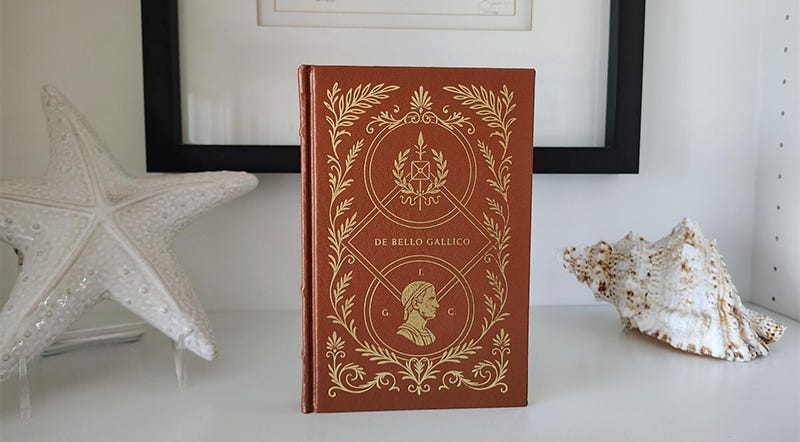
Castalia Library makes the world’s most beautiful leather books at its own bindery in Switzerland. Castalia House is the premier translator of never-before translated works from Japanese, Spanish, French, Italian, and German into English. To support Castalia House’s historic translation efforts and receive a new translated ebook every week, support the Alexandria project, and get future access to Castalia Unlimited, become a paid subscriber to this substack. And to receive a premium deluxe leatherbound book every three months, subscribe to Castalia Library.
These are all such exciting stories. Thank you for translating them and making them available!
The Japanese Captain Flagg and Sergeant Quirt here....