



NEW RELEASES
Romance of the Three Kingdoms Vol. 8: The Southern Campaign by Eiji Yoshikawa
Romance of the Three Kingdoms Vol. 9: The Northern Memorial by Eiji Yoshikawa
THE DRAGON MARCHES SOUTH
Liu Bei has claimed Shu. For the first time in his life, the man who spent twenty years as a wanderer, a guest, and a fugitive, rules a kingdom of his own. The north belongs to Cao Cao. The east belongs to Sun Quan. And the the vast, unmapped territories beyond the rivers to the south belong to no one, which means it belongs to whoever takes it first.
The Dragon, no longer sleeping, turns his attention southward, and what follows is unlike anything else in the Three Kingdoms saga. This is not a war of rival strategists matching wits across a battlefield. This is a campaign fought against terrain itself, against jungle, fever, rivers that appear on no map, and warlike tribal kings who know the land better than any invader ever could. Kongming cannot win by conquest, but only by transforming his most determined enemy into his most loyal ally.
But the campaign in the south is only half the story. In the north, an unexpected death reshapes the political landscape, and the question that has haunted the saga from its opening pages takes on a new and urgent form. The sons of heroes have inherited their fathers’ wars and not all of them are equal to the burden.
This is the eighth book in the first complete and unabridged English translation of Yoshikawa’s Sangokushi, the novel that defined the Three Kingdoms classic for modern readers across Asia. An original Castalia House translation.

Excerpt
Sima Yi Zhongda held the post of Chief Clerk of the Central Army. Throughout the Hanzhong campaign, he had served at Cao Cao’s side. In the governance of the conquered territories, he had been taking an increasingly active hand, and the keenness of his talents, together with a certain angular sharpness of character, was beginning to make itself felt. One day, he laid a proposal before Cao Cao.
“Wei’s advance into Hanzhong has shaken western Shu to its foundations and thrown Xuande into confusion. His nature is slow and ponderous. If Your Grace were to strike now, swift as the gale and sudden as the thunderbolt, the edifice of his new domain would shatter like falling tiles.”
Liu Ye, one of the senior ministers, added his voice.
“Zhongda speaks for all of us. Given time, they will be beyond our reach. In civil affairs they possess Kongming, and in arms the Five Tigers: Guan Yu, Zhang Fei, Zhao Yun, Huang Zhong, Ma Chao. They are no longer the ragged host we once dismissed. The day approaches when Xuande will be too strong to break. If we mean to destroy him, it must be now.”
He pressed the point with vigor.
Had this been the Cao Cao of former years, the matter would have been settled without a second opinion. But the signs of encroaching age had been upon him since Chibi. Now, too, he held back.
“Having won Long, must we at once covet Shu? The men and horses are spent. They need rest.”
He showed no inclination to move.
The situation in Shu was, in truth, every bit as grave as Sima Yi supposed. Wei’s advance had sent a deep tremor through the country, and rumors flew thick and wild: Cao Cao on the verge of breaching the border, the invasion all but under way. Xuande’s new order was still in its infancy, the roots barely established, and Xuande himself could not suppress a mounting dread.
When the question of what was to be done came before the council, Kongming stated the position with his customary clarity.
“Wei’s hunger for expansion is the impulse of a living thing to grow. Turn that impulse elsewhere, let it spend its force in another direction, and Shu will be safe for the present. In that interval, we build our defenses.”
Having laid this foundation, he continued.
“Send an able envoy to Wu. Return the three Jingzhou commanderies we previously agreed to cede, and at the same time make plain the dangers of the hour and where the mutual interest lies. Persuade Sun Quan to attack the fortress at Hefei. It is a position of the first importance to Wei; Cao Cao stationed Zhang Liao there for that very reason. The moment Hefei comes under threat, Wei will turn its full attention southward, and the weight upon Shu will lift of its own accord.”
“The plan is bold and far-reaching. But who among us possesses the skill to carry such diplomacy?”
Xuande let his gaze travel across the assembled faces. His eyes met those of one man in the company. That man rose at once.
“I will go.”
He spoke with quiet composure. The assembly turned to see who it was.
It was Yi Ji.
“If it is Yi Ji,” Kongming said with a nod, and the whole company placed its trust in the man. Bearing Xuande’s letter, Yi Ji set out down the long reach of the Yangtze.
Before arriving in Wu, he put ashore at Jingzhou and met with Guan Yu in secret, to convey Xuande’s intentions and Kongming’s strategy and to settle the necessary arrangements in advance.
In Wu, the proposal fractured opinion on every side. Some, still seething over Guan Yu’s conduct at the Linjiang conference, would hear nothing of it.
“Refuse. Absolutely.”
Others took the opposite view.
“Reject this offer, and we abandon our claim to Jingzhou altogether. Accept the three commanderies while they are being offered.”
This camp, too, had its adherents.
Yi Ji pressed a further argument.
“Should Wu attack Hefei, Cao Cao will find his position in Hanzhong untenable and withdraw to the capital in haste. Xuande will seize Hanzhong at once. He will then recall Guan Yu to garrison Hanzhong, and the whole of Jingzhou, every district, will be returned to Wu.”
So the three commanderies came, in effect, with a condition attached. In the end, the counsel of Zhang Zhao, Gu Yong, and the others all inclined toward acceptance. Sun Quan made his decision, agreed to every term Yi Ji had proposed, and once again dispatched Lu Su to Jingzhou to take possession of the ceded territories.
THE HISTORIC LETTER
Before he marches north, Kongming writes a letter to his emperor. It is not a military dispatch or a request for orders. It is something unique in Chinese history, a testimonial by a man who knows what is coming, who is writing everything he wants the boy he raised to understand after he is gone. Remember your father. Trust these men. Do not trust these men. Rule justly. I am leaving now, and I may not return.
The Chūshihyō — the Memorial on the Sending Out of the Army — is one of the most celebrated documents in Chinese literature. Chinese tradition holds that no man can read it without weeping. In Yoshikawa’s hands, it becomes the emotional summit of the entire Three Kingdoms saga, the moment where strategy falls away and what remains is a man, his duty and the knowledge of everything he has given up to follow it
Volume Nine follows Kongming’s first northern expeditions against Wei, campaigns fought not with the overwhelming force of Red Cliffs but with deception, misdirection, and the desperate tactics of a smaller kingdom striking upward at a larger one. Beside him stands a new generation of officers. Against him stands Sima Yi, the one mind in all of Wei that may be his equal. The battles are brilliant. The setbacks are crushing. And behind it all, the reader knows what Kongming knew when he wrote the memorial: that this is a war that cannot be won, only fought until its bitter end.
This is the ninth book in the first complete and unabridged English translation of Yoshikawa’s Sangokushi, the novel that defined the Three Kingdoms classic for modern readers across Asia. An original Castalia House translation.

Excerpt
“What? Jingzhou has fallen?”
Guan Ping’s will to fight drained from him. He abandoned Xu Huang and fled headlong back the way he had come. His mind was in chaos.
Could it be true? Surely not.
The doubt and dread churned together as he rode.
When he came within sight of Yancheng, the castle was belching great columns of black smoke. Soldiers of his own army were scattering from beneath the flames like spiders from a burning web. He seized one and demanded an explanation.
“Xu Huang’s troops slipped around to the rear gate before anyone knew they were there. They set fires everywhere and stormed in.”
The men said much the same thing, one after another.
“Then today’s battle was nothing but a trap, and we walked straight into it.”
He stamped the ground and cursed, but it was too late for curses. Driving his horse hard, Guan Ping raced for the fortified camp at Sizhong.
Liao Hua met him and brought him into the camp at once.
“Today, from no direction I could name, voices began spreading the word that Jingzhou has fallen, that Wu has taken it. Did you hear this as well?”
Guan Ping drew his sword. He strode into the midst of his own troops and gave Liao Hua his answer in a voice meant for the entire army.
“These rumors are nothing but the enemy’s stratagem to break our will. Any man who repeats such lies, or who takes an interest in repeating them—I’ll cut him down where he stands.”
For several days they held fast and did nothing but observe the surrounding terrain and the enemy’s dispositions. The position at Sizhong was a strong one: the Mian River flowing before it, the main approaches secured with barricades, and behind it a labyrinth of ravines, mountains, and deep forest through which not even birds could easily pass.
“Xu Huang has been riding his victory hard, pressing forward recklessly. The scouts report he has advanced as far as that mountain yonder. It is bare ground, no advantage of terrain at all. Our position here at Sizhong, on the other hand, is all but impregnable; even a thin garrison could hold it. I say we slip out together, you and I, and strike him by night.”
The loss of Yancheng had left Guan Ping burning for revenge. He persuaded Liao Hua, and together they sortied from the main camp, taking with them only the finest of their elite.
Across the open ground, a single command post stood upon a low hill. This was the foremost line: a chain of twelve small garrisons strung out at wide intervals across the plain. If the enemy broke through at any one point, all twelve would be cut off from one another. It was precisely the gravity of this risk that had drawn Liao Hua to follow Guan Ping’s aggressive instinct.
“Tonight I will lead the assault on the bare mountain myself. You hold this line. When you see the enemy fall into disorder, drive the twelve posts forward as a single connected front, crush them into a pocket, and slaughter the fugitives to the last man.”
With these instructions, Guan Ping left Liao Hua behind and struck at the bare mountain alone in the deep of night.
The summit was deserted. Banners stood planted in the earth, but not a soldier remained.
“A trap.”
He wheeled to descend, but from every cave and crevice, from behind every boulder, from the far side of the mountain, there erupted at once a roar so vast it seemed the very earth was splitting apart: war cries, explosions, curses, battle shouts, a tidal wave of sound that crashed over him from every quarter.
Lü Jian and Xu Shang, the two commanders of the ambush, taunted him as they closed in.
“Boy! Did your father teach you nothing but how to run?”
Guan Ping fought clear of the mountain and gained the open plain, but the Wei troops only multiplied. Every blade of grass seemed to sprout a soldier; the whole field was alive with men hunting him down.
Liao Hua’s line could not withstand the flood. It shattered in a single stroke. And worse still: from Sizhong itself, from the main camp they had left behind, flames were already clawing at the night sky.
Gasping and bleeding, Guan Ping reached the bank of the Mian River only to find Xu Huang himself already planted there, his horse set squarely across the ford.
“Not one of them crosses.”
The annihilation cordon was seamless. Not a gap, not an oversight.
There was nothing left to salvage. It was total defeat. Guan Ping and Liao Hua had no choice but to flee to Fancheng. When they came before Guan Yu, they fell to their knees.
“We have no excuse.”
Guan Ping ground the tears from his eyes with his fists.
“Such things are the fortune of war.”
Guan Yu did not rebuke them. But when Guan Ping reported the rumors about Jingzhou, his father’s tone changed at once.
“Nonsense.” His voice was sharp. “The commander at Lukou is a child. The beacon towers are in place. Jingzhou is as safe as Mount Tai itself. If even you let yourself be taken in by the enemy’s fabrications, what hope is there for the rest?”
The rebuke was harsh and absolute.
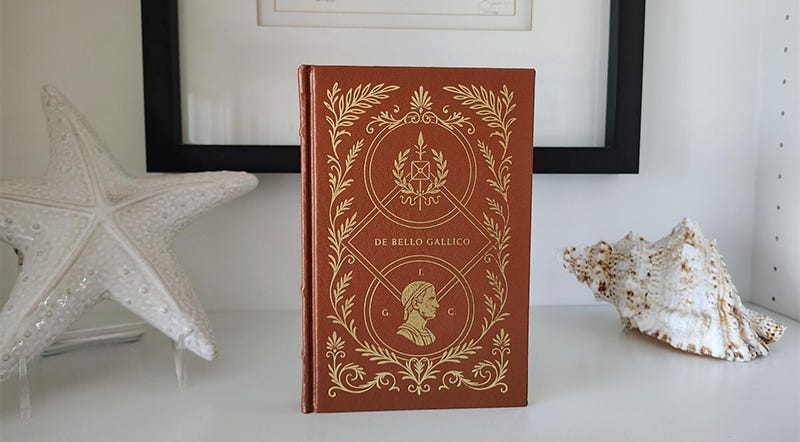
Castalia Library makes the world’s most beautiful leather books at its own bindery in Switzerland. Castalia House is the premier translator of never-before translated works from Japanese, Spanish, French, Italian, and German into English. To support Castalia House’s historic translation efforts and receive a new translated ebook every week, support the Alexandria project, and get future access to Castalia Unlimited, become a paid subscriber to this substack. And to receive a premium deluxe leatherbound book every three months, subscribe to Castalia Library.