



NEW RELEASES
Romance of the Three Kingdoms Vol. 10: Wuzhang Plains by Eiji Yoshikawa
THE END OF THE GRAND SAGA
A falling star appears over the plains of Wuzhang, and the man who saw it understands the omen.
Zhuge Liang has given his all. Six northern campaigns, each one successful, but insufficient to win the war. The kingdom of Shu is too small, its resources too thin, and its emperor too weak to hold what his father built without the man who has borne the burden of responsibility upon his shoulders. Kongming knows the future. He has always known it. He came down from his secluded mountain against his better judgment, and he has been at war with destiny ever since.
Volume Ten of Yoshikawa Eiji’s saga is the final act. Kongming and Sima Yi face each other for the last time across the plains, and the duel between them is no longer just a contest of strategies, but a war against time itself. Kongming’s body is failing. He neither eats nor sleeps, and the men who follow him can see what is happening and know what is coming. When the end comes, it is stranger and more haunting than anything that came before.
After the Dragon falls, the story does not end. Instead, it transforms. The age of heroes gives way to the age of heirs, and the passage from Wei to Jin completes the long arc that began in a peach garden with three men and an oath. The Three Kingdoms are gone. What they represented endures to this day.
This is the finale of the complete, unabridged English translation of Yoshikawa’s Sangokushi. An original Castalia House translation.

Excerpt
Express riders from the Wei River came galloping into Luoyang one upon the next, close as the teeth of a comb.
Every one of them carried a report of defeat.
Emperor Cao Rui, the colour draining from his face, assembled his ministers and addressed them in a voice heavy with dread. Was there no one among them who could save the state?
Hua Xin offered his counsel.
“There is nothing for it, Your Majesty, but for the Emperor himself to advance the imperial carriage to the Wei River and kindle the fighting spirit of the three armies. However many generals you may appoint and replace, each change serves only to embolden the enemy further.”
Grand Tutor Zhong Yao opposed this without equivocation.
“‘Know the enemy; know yourself; and in a hundred battles you shall win a hundred victories.’ So the ancient proverb runs. Cao Zhen was outmatched by Kongming from the first. Even should Your Majesty take the field in person, you could scarcely compensate for his deficiencies, and in the event of yet another defeat, the very survival of the state would hang in the balance. There is a better course: seek out some great man who has withdrawn from the world, invest him with the seal of command, and set him against Kongming. No other strategy will serve.”
Zhong Yao was the senior elder of the Wei court. Who was this great man in retirement? The emperor bade him speak the name without reserve.
“The man I speak of is none other than Sima Yi, styled Zhongda. Some years ago, Your Majesty fell victim to an enemy’s stratagem of division and gave credence to the rumours circulating in the streets. His dismissal was an irreparable loss. By all reports, Sima Yi now lives in quiet retirement at Wancheng, his home district. To bury a mind of that calibre in obscurity while the nation stands in mortal danger is unconscionable. Today, Your Majesty, is the day to summon him.”
The emperor’s regret was plain upon his face. The wound had been festering long before Zhong Yao laid a finger on it. Now, confronted with the accusation, the shame showed deeper still.
“It was the great error of my reign. But the man was wrongfully cast out, and his resentment must run deep. He has buried himself in the countryside. Will he obey a summons now, after all that has passed?”
“Send the imperial envoy. Sima Yi is, at the root of his nature, a man whose devotion to the state will not be gainsaid. He will answer the call.”
So be it. The emperor dispatched an envoy bearing the seal and credentials of Regional Commander of the West, together with an imperial edict whose urgency was beyond concealment: You who grieve for the nation: gather the armies of the Nanyang roads, fix a day, and march upon Chang’an. We shall ready the imperial retinue and proceed to Chang’an ourselves, that we may meet and together break Kongming.
In those same days, Kongming, from his position at Qishan, was preparing to seize the momentum of his victories.
“The hour is at hand. We take Chang’an, and from Chang’an we drive on to Luoyang itself.”
One victory following hard upon the last, the momentum was irresistible; he meant to strike at the heart of Wei in a single sustained blow. He was deep in these preparations when Li Feng, the son of Li Yan, garrison commander of White Emperor Castle, arrived without warning.
From the very location of that garrison, one conclusion presented itself at once: Wu must have begun to move. It could not be a trivial matter. But when Kongming summoned Li Feng and heard what the young man had to say, there was nothing of the kind.
“I come on my father’s behalf, Chancellor, bearing good tidings.”
“Good tidings? Of what sort?”
“You will recall, Chancellor, how in former days, when General Guan Yu was destroyed at Jingzhou, a man named Meng Da bore no small part of the blame for that disaster. Meng Da, who betrayed Shu and went over to Wei.”
“I have not forgotten him. What has Meng Da done now?”
“The matter stands thus.”
Li Feng laid it out. After his defection, Meng Da had for a time enjoyed the trust and favour of Cao Pi. But since Cao Pi’s death and the accession of the present emperor, Cao Rui, his standing had declined steeply. Of late he had found himself slighted at every turn, and the old suspicion that clung to a former minister of Shu had sharpened against him until his life was one of bitter, unrelieved discontent. His subordinates, too, had come to long for their former country; the reports of Kongming’s victories at Qishan and along the Wei River had filled them with remorse for ever having abandoned Shu.
At last Meng Da had set down his feelings in a long and heartfelt letter, imploring Li Yan at White Emperor Castle to intercede with the Chancellor on his behalf and secure his return to service.
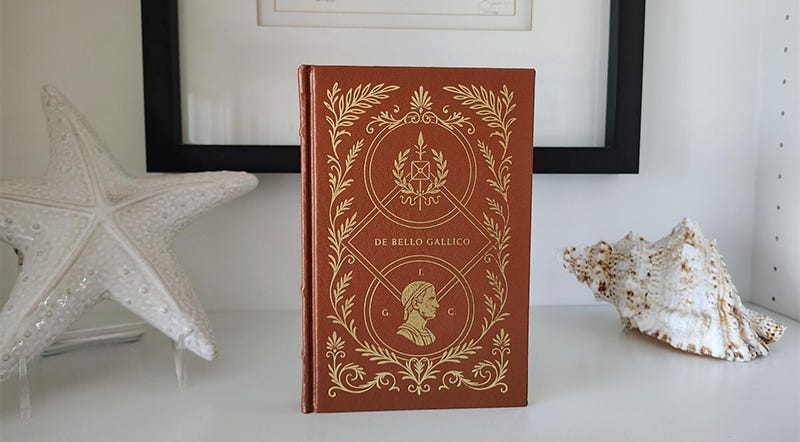
Castalia Library makes the world’s most beautiful leather books at its own bindery in Switzerland. Castalia House is the premier translator of never-before translated works from Japanese, Spanish, French, Italian, and German into English. To support Castalia House’s historic translation efforts and receive a new translated ebook every week, support the Alexandria project, and get future access to Castalia Unlimited, become a paid subscriber to this substack. And to receive a premium deluxe leatherbound book every three months, subscribe to Castalia Library.
So...news of a hardcover or leather edition soon?