


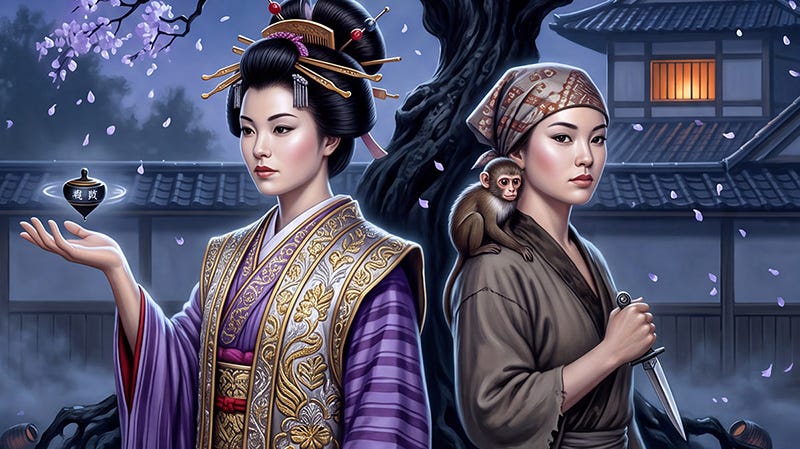
Kunieda Shirō (1887–1943) was one of the great inventors of Japanese popular fiction. Born in the mountain country around Lake Suwa in Nagano, he studied English literature at Waseda and began his career in the theater, first as a drama reporter for the Osaka Asahi Shimbun and then as a resident playwright in Osaka. Around 1920 illness forced him out of the theater, and he turned to fiction. What he created there was something new: the denki shōsetsu, the “tale of wonders,” historical adventure charged with sorcery, secret societies, cursed treasures and the grotesque, set in an Edo period that never quite existed.
Through the 1920s and 1930s his serials filled Japan’s newspapers and magazines. The Castle of Blood-Dyed Silk (1925–26), with its masked lord and its castle of terrors, is his most famous book, and Mishima Yukio was among those who praised it highly. The Demon God of Mount Yatsugatake and Ivy on the Hanging Bridge of Kiso made his name. Alongside them he wrote swashbuckling vendetta tales, ghost stories and mysteries in a style all his own: lush, fevered and cinematic, as at home with a midnight duel as with a dying beauty or a hidden cipher. After his death in 1943 he fell out of fashion, until a revival in the 1960s and 70s brought him back into print in Japan as a cult classic.
The Avenging Sisters is the second-to-last book of the week for paid subscribers; next week we will launch Castalia Unlimited and everyone will be able to select whatever books they like from our expanding library of books, including the translations from Japanese, Spanish, Italian, French, and German, for starters. But we will include a Book of the Month for all subscribers in order to be able to introduce everyone to authors with whom they were not previously familiar.
And, of course, if you’d like us to continue recommending a specific book each week, we can certainly do that. If you’ve got an opinion on that, feel free to leave a comment with your suggestions. We’re entering uncharted territory here, and we don’t pretend to have all the answers. In the meantime, the book has already been sent out to the paid subscribers.
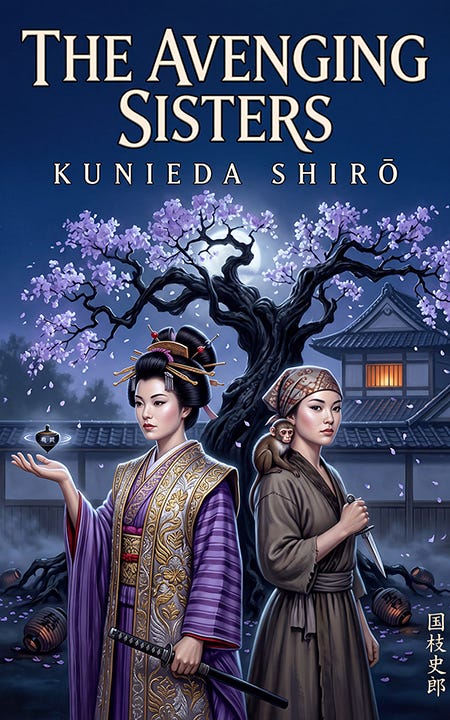
THE AVENGING SISTERS
On a spring evening in Ryōgoku, the young samurai Yamagishi Chikara, a page in the house of Lord Tayasu, watches the trick-top artist Naniwa Ayame send her tops spinning across a stage of painted cherry blossoms. On his way home he finds a small black lacquered top in his sleeve. When it spins, characters appear on its face. Hidden inside is a cipher that points to the lost treasure of the Yodoya, the merchant house whose vast fortune was confiscated by the shogunate. And the Tayasu mansion has been plagued by strange thefts, in which costly objects vanish one after another while money is left untouched.
Soon there are bodies. Waiting-women die mysteriously in the Tayasu grounds, where someone has planted the Tree of Utmost Evil, a poison tree raised over thirty years by a sorcerer with a grudge. A band of thieves posing as nurserymen moves through the city at night, and a white-bearded old magician leads a secret brotherhood of street performers. Behind it all stands Matsuura Tanomo, chief retainer of the inner household, who will stop at nothing to have the top. When Ayame is reunited with her twin sister Oyō, now a monkey-showwoman, after ten years apart, the two daughters of the ruined Ebara house learn who killed their father and stole their inheritance, and they swear revenge.
First serialized in the magazine Kōdan Zakki from January to October 1936, The Avenging Sisters is Kunieda Shirō in compact form: a cipher, a hidden fortune, a poison tree and two sisters with their daggers drawn, in a swift, moonlit mystery of old Edo.
EXCERPT
Ochanomizu in those days was a world apart, formed of trees, thicket, ravine and river: a forest in the heart of the city.
By day people came and went, but after dark almost no one passed that way; only those too pressed for time to take the long way round would enter, and they hurried through at something near a run, fearful all the while.
It was past the Hour of the Boar when Yamagishi Chikara came through.
That Ayame had vanished without trace, that the showmaster called Kanbē had been struck dead by some unknown hand: these two unexpected events had shaken even him, and until now he had been wandering the streets of Edo without aim or direction.
What is the Ebara house?
The question would not leave him.
The name had appeared among the top’s ciphers. The man Kanbē had spoken it. And the trick-top artist Ayame, too, seemed bound to that house by something.
There was such a house, he had once heard in passing, in the village of Magome in the Ebara district.
But what he had heard, and that only at second hand, was no more than this: that it was a very old house, a rare and ancient family that had kept an unbroken and true bloodline since time out of mind.
But now, as things stand, I had better look into whatever that house may hold.
So Chikara thought.
The top, of course, still troubled him.
However much he spun it, no new ciphers seemed likely to appear beyond those already found. And those ciphers alone told him nothing of any secret. It seemed, indeed, that there must be several other tops besides his own in which ciphers lay hidden, and that only when every top was gathered and every cipher known would the secret at last come clear.
A great undertaking indeed.
He could not think otherwise.
But what weighed most heavily on Chikara’s mind, pressing it into a dark and troubled cast, was that the string of thefts at the mansion and Ayame in her monkey-showwoman’s disguise were closely bound together; it was to learn the truth of this that he had gone to the theater that day.
The top and the cipher from the monkey-show woman, and my own suspicion that someone inside the mansion is passing information: I sent it all to Lord Matsuura early this morning. Has a woman accomplice been found inside the mansion, I wonder?
He walked on, thinking.
A great rotted tree lay fallen across the way; moonlight pooled in standing water; from the shadow of a thicket a beast that might have been a fox darted suddenly across his path.
Then, without warning, a woman’s voice.
“Look out! Take care! From behind!”
In that instant Chikara threw himself to the ground.
“Ah!”
The cry came from a swordsman rushing him from behind: he stumbled over Chikara’s body and went crashing headlong beyond.
Quick as wind and lightning, a second swordsman closed from the left and with joined hands swung down at Chikara where he still lay.
The man screamed, a raw and broken sound. Blood was jetting from his flank, showing black in the moonlight that filtered through the branches.
By the time that swordsman toppled with his feet in the air, stiff as a log, Yamagishi Chikara, peerless in the Ono school of swordsmanship, had long since sprung to his feet, drawn in the very act of rising, and in the instant of the draw cut his enemy down; untouched by so much as a drop of the man’s blood, he stood with his back set against the trunk of a great camphor tree that towered there.
Yet for all that, what a host of swordsmen surrounded him!
I would appreciate the continued weekly book recommendations.