



THE BOOK OF WILD GRASSES is first book of Shin Heike Monogatari, the epic tale of the Heike.
The first book of the epic opens in the crumbling mansion of a minor Taira warrior, where the young Kiyomori grows up listening to his parents quarrel, with his noble Fujiwara mother raging against the indignity of poverty, his father Tadamori sitting in stony silence. From this unpromising beginning, Yoshikawa traces Kiyomori’s passage from adolescence to early manhood against the backdrop of a capital alive with ambition, pleasure, and violence. The mystery of Kiyomori’s true parentage — he may be the secret son of the Cloistered Emperor Shirakawa — hangs over the narrative, shaping both his self-doubt and his uncanny rise.
Around him, a generation of young warriors comes of age: Norikiyo, the gifted poet who will renounce the world to become the monk Saigyō; Minamoto no Yoshitomo, the Genji heir who will one day be Kiyomori’s mortal enemy; and Endō Moritō, whose obsessive desire for the beautiful Lady Kesa ends in a murder that shocks the capital and reveals the savage undercurrents beneath courtly refinement.
Woven through these coming-of-age stories is Yoshikawa’s portrait of late Heian society in all its contradictions, a world of moonlit poetry gatherings and ox-cart processions where political power flows through pillow-talk and adoption, and where the warrior clans the court despises are the only force capable of keeping order. Kiyomori courts and marries Tokiko, finds his footing in the capital’s treacherous politics, and by the final chapter has moved into a grand new mansion at Rokuhara, the stronghold that will become synonymous with Taira power. Yet even as Kiyomori marvels at his own good fortune, the Minamoto are adding to their strength with eastern warriors. The stage is set, and both clans are moving toward a collision neither has foreseen.
While only the first two books have been previously translated, only Castalia House has completed the translation of the 24 books of the Yoshikawa’s million-word epic, which will be available in its entirety when Castalia Unlimited launches in two weeks. You can already sign up for Castalia Unlimited pre-launch if you wish to be alerted when it goes live.
An ebook of The Book of Wild Grasses, has already been sent to all of the paid subscribers. It is also available on Amazon.

Excerpt
Heita Kiyomori was born in the first year of Gen’ei. His father, Taira no Tadamori, was twenty-three.
Of late, Tadamori had become a byword for the lowborn — “Lord Squint-Eyes,” they called him, and “the beggarly Taira” — scorned even by his own clansmen and kin. But it had not always been so.
Kiyomori’s grandfather, Taira no Masamori, had served three reigns: Shirakawa, Horikawa, and Toba. He enjoyed deep imperial trust as “a warrior who knows his place and proves himself useful.” His son Tadamori likewise grew up amid the luster of that reputation, and it was precisely in the span of these two generations, father and son, that the Taira fortunes turned. As the Minamoto warriors who had once been prominent, Minamoto no Yoshiie foremost among them, receded from favor, Taira men from the provinces were gradually called to serve at the capital.
Cloistered Emperor Shirakawa had employed Masamori and his son as instruments for removing the Minamoto figures who displeased him. He set them against the military power of the great monasteries, and used them within the court to hold the Fujiwara in check. Even after his abdication, Shirakawa kept firm hold of the reins of government, inaugurating what came to be known as “cloistered rule.”
But this deformed new system, and Shirakawa’s autocratic hand in the appointment of men, quickly bred conflict between the reigning court and the cloister. From that double root, a greater division was already taking hold:
Genji against Heike.
The rivalry spread even among the provincial warriors. The conviction was forming that a man must ally himself with one house or the other or be left behind by the tide of the age. Edicts forbidding such partisan allegiance were issued, declaring that none should rally to the Genji or rush to the Heike without cause, nor wield military force at will. They had almost no effect.
When Masamori died, Tadamori succeeded him. Cloistered Emperor Shirakawa found the son even more congenial than the father and valued him accordingly.
There is, for instance, this one episode.
The Cloistered Emperor’s residence stood at Sanjō Nishi-no-Tōin. From there, always at night, he would from time to time cross the Kamo River and steal away to Gion. His escort was invariably the same two men: Tadamori of the Warriors’ Bureau, and Tadamori’s retainer, Iesada.
The visits were, of course, to a woman. The Cloistered Emperor was nearing sixty, yet his appetite in that quarter was, by all accounts, extraordinary. The vigor that age could not diminish showed equally in his boundless political energy.
Nor, by the customs of the age, was there anything scandalous in it. For a man of such station to keep a lover in a separate dwelling and visit her from time to time was nothing anyone found remarkable. That a man should call at a woman’s bedchamber was an ancient practice, observed by the courtiers of Nara and Heian alike. Prince, regent, minister: none considered such discreet liaisons beneath their dignity, or a matter touching their honor.
Yet there was a further reason, kept from the world, why the Cloistered Emperor’s visits demanded such secrecy. The woman, it appeared, was of low birth.
The term shirabyōshi had only recently come into currency, and she was one of them. Entertainers invited to the great mansions to grace gatherings with music and dance had existed since antiquity. But of late it had become fashionable for these women to don tall eboshi caps and white suikan robes, to wear sheathed swords at their sides, and to perform men’s dances while chanting verse. With this fashion, a new class called shirabyōshi had emerged among the ranks of courtesans.
Where the Cloistered Emperor first became intimate with her was unclear. To the world it was given out that she was a daughter of the Nakamikado house. An elegant dwelling was built near Yasaka, surrounded by a fence of cypress bark, and a certain beauty of shirabyōshi origins was quietly installed there. Only four or five men in the Cloistered Emperor’s inner circle knew the truth from the start.
Among themselves, they called her the Lady of Gion. Since titles like “Consort” and “Lady of the Chamber” belonged properly to the palace, they deliberately attached a place name, maintaining to the world the fiction that she was merely some retired courtier’s favorite.
The Lady of Gion. This woman was Kiyomori’s mother. She bore him; that much is beyond dispute.
But the father? Who was the father?
On that question, the secret becomes a riddle that no one but she herself could have solved. Why should so simple a matter have to be thought a riddle at all? Why should it drive her child to anguish a full twenty years after his birth? That in itself was perhaps the deeper mystery.
Yet the ground that bred such misfortune belonged to the age. It was one of the molds that grew naturally in the “beauty of shadows,” that aristocratic life swathed in the supreme elegance and refinement of Heian art. For those whose customs and morality had been shaped across centuries of such living, perhaps none of this was extraordinary at all.
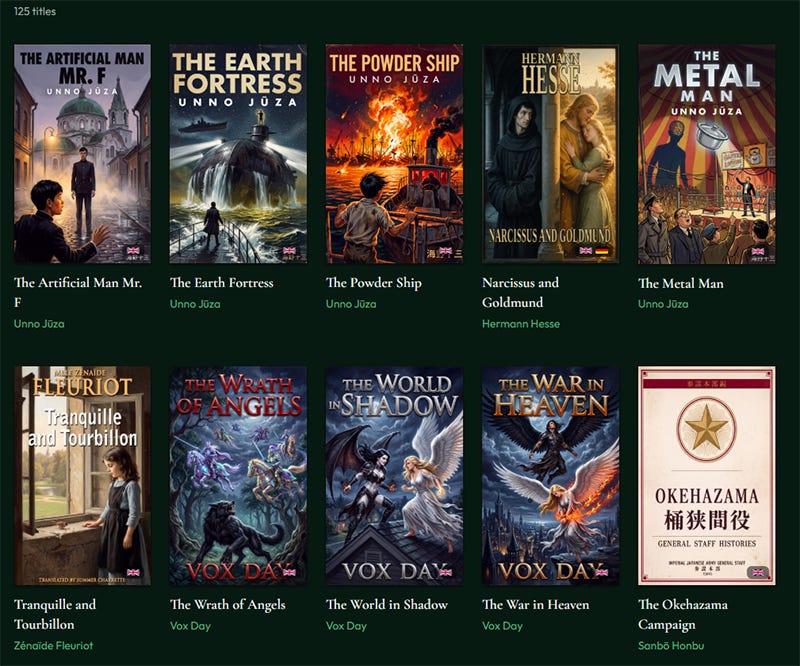
As 20 percent of the voting subscribers indicated that they would prefer not to be automatically enrolled in a second email list devoted to Castalia Unlimited, we will initiate a new opt-in policy for that. To explain what sort of updates we will be sending out to those who opt-in but are not paid subscribers of Unlimited, here are the ten most recent additions to CU, all of which were added this weekend.
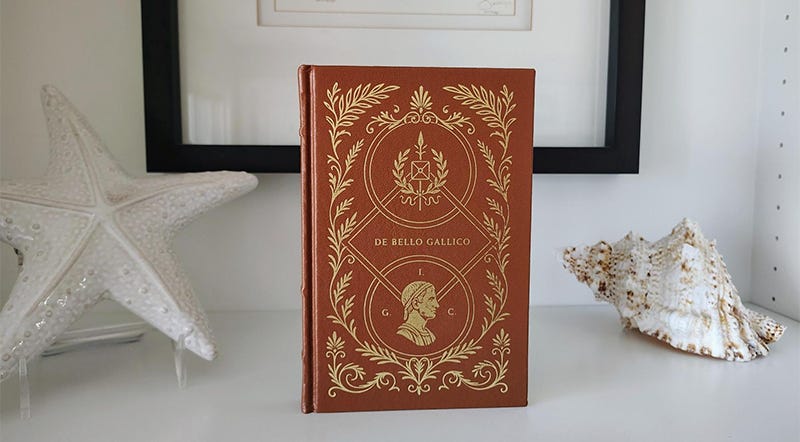
Castalia Library makes the world’s most beautiful leather books at its own bindery in Switzerland. Castalia House is the premier translator of never-before translated works from Japanese, Spanish, French, Italian, and German into English. To support Castalia House’s historic translation efforts and receive a new translated ebook every week, support the Alexandria project, and get future access to Castalia Unlimited, become a paid subscriber to this substack. And to receive a premium deluxe leatherbound book every three months, subscribe to Castalia Library.