



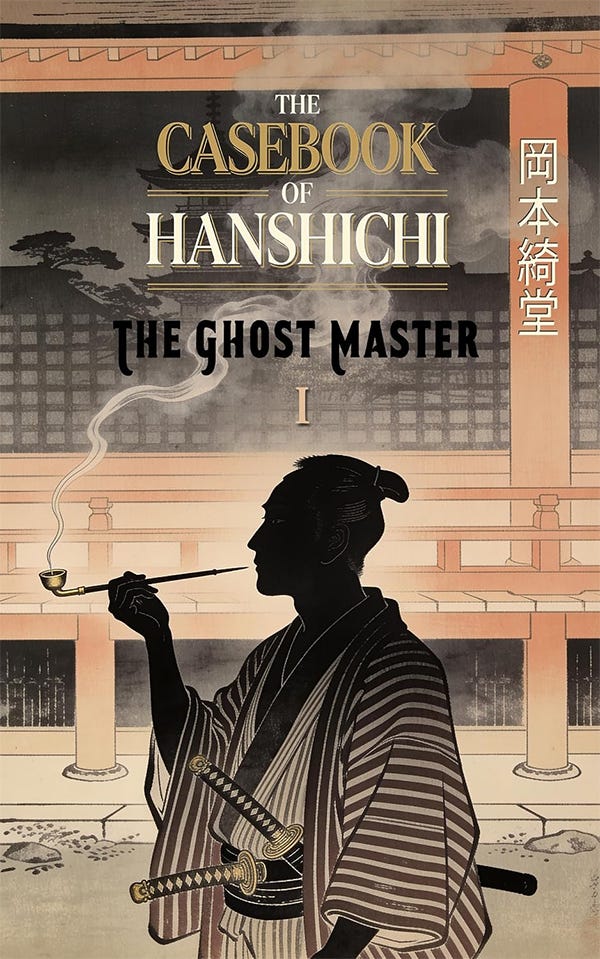
The Casebook of Hanshichi Volume I: The Ghost Master by Kidō Okamoto is this week’s new translation.
In 1917, the great Kabuki playwright Okamoto Kidō set out to do something no Japanese writer had done before: write detective fiction set in the Edo period. Inspired by Arthur Conan Doyle’s Sherlock Holmes, he created Hanshichi, a retired thief-taker who spins tales of his old cases over tea and fine sweets in his Akasaka parlor, while a young writer fills notebook after notebook with the old man’s stories. The result was the Hanshichi Torimonochō, a 68-story cycle published over two decades that became one of the most beloved mystery series in Japanese literary history.
Hanshichi is the Sherlock Holmes of old Edo, and his creator knew it. Okamoto himself called his detective “the hidden Sherlock Holmes of the Edo period.” But where Holmes stalks the gaslit streets of Victorian London, Hanshichi works the shadowed lanes and canals of a world on the brink of extinction: the last decades of the Tokugawa shogunate, where samurai and commoners, courtesans and monks, ghosts and grifters all collide under the watchful eye of a man who sees through every deception. These are mysteries steeped in atmosphere, period detail, and a deep understanding of human frailty. Vengeful spirits that turn out to be something worse than ghosts. Domestic tragedies played out behind the walls of samurai mansions. A monkey sentenced to exile on a distant island. An otter that solves a crime from beyond the grave.
Despite the series’ towering reputation in Japan, the vast majority of the sixty-eight stories have never been translated into English. This first volume of The Casebook of Hanshichi presents ten complete stories in literary translations that read as English prose in its own right while capturing the unique atmosphere and wry humanity of Okamoto’s originals. From the eerie opening of “The Spirit of Ofumi” to the theatrical curtain-fall of “Hiroshige and the Otter,” this is detective fiction as it was meant to be read: slowly, by lamplight, with the rain drumming on the leaves outside.
The ten stories included in the first volume are:
1. The Spirit of Ofumi
2. The Stone Lantern
3. The Death of Kanpei
4. Upstairs at the Bathhouse
5. The Ghost Master
6. The Mystery of the Fire Bell
7. The Lady-in-Waiting
8. The Sash-Snatching Pond
9. Spring Thaw
10. Hiroshige and the Otter
The collection also includes a preface written by the author himself in 1927.
About the Author
Okamoto Kidō (岡本綺堂, 1872–1939) was a playwright, novelist, and essayist whose career spanned the Meiji, Taishō, and early Shōwa eras. Born in Tokyo to a former samurai family, he grew up steeped in the customs and oral traditions of a city still living in the shadow of the old regime. He became one of the leading figures in the shin-kabuki (new Kabuki) movement, writing plays that brought psychological realism to the classical stage, and was widely regarded as the foremost Kabuki dramatist of his generation. His deep knowledge of Edo-period law, social hierarchy, and daily life gave the Hanshichi Torimonochō its extraordinary texture and authority. The series, published between 1917 and 1937, established the torimonochō genre — period detective fiction set in Edo — and inspired generations of Japanese mystery writers. Okamoto’s work remains in print in Japan more than eighty years after his death.
Excerpt
My uncle was born in the closing years of the Tokugawa shogunate, and he knew a great many of the dark legends that had been current in that era: stories of forbidden rooms in haunted mansions, of the living spirits of jealous women, of the vengeful ghosts of men consumed by old grudges. Yet my uncle had been raised under the samurai conviction that a warrior ought never to credit the supernatural, and this principle, once instilled, never left him. It survived the fall of the shogunate and the coming of the new age intact. When we children began, as children will, to trade ghost stories among ourselves, my uncle would frown and refuse to take any part.
Only once did he let his guard slip.
“And yet,” he said, “there are things in this world one cannot account for. That business with Ofumi, for instance...”
No one knew what the Ofumi business was. My uncle, plainly mortified at having contradicted his own principles, would say nothing further, and my father, when I asked him, would tell me nothing. But from the way my uncle had spoken I gathered that a man we called Uncle K was somehow involved in the affair, and my curiosity eventually drove me to Uncle K’s house to ask him directly. I was twelve at the time. Uncle K was no blood relation of ours; he was a friend of my father’s from before the Restoration, and I had called him “uncle” since I could remember.
Uncle K was no more forthcoming.
“Never mind all that. Silly ghost stories will only get you in trouble with your father and your uncle.”
Uncle K, who ordinarily loved nothing better than to talk, kept his mouth firmly shut on this one subject, and I had no purchase from which to press him. Physics and mathematics were being crammed into my head at school in relentless daily doses, and there was scarcely room for anything else. The name Ofumi faded from my thoughts like smoke.
Two years passed. It must have been late November, as I recall. A cold rain had begun to fall while I was walking home from school, and by nightfall it had settled into a steady downpour. Uncle K’s wife had gone to the Shintomi-za that morning with a neighbor.
“I shall be minding the house tomorrow evening,” Uncle K had told me the day before. “Come and keep me company.”
I kept the appointment, finishing my supper and setting out at once. Uncle K’s house was only four blocks from ours as the crow flies, but it lay in the Banchō district, where the old samurai mansions of the Tokugawa era still stood, relics of a vanished order. Their bulk laid a kind of permanent shadow over the streets, so that even on clear days the neighborhood felt overcast. On a rainy evening it was desolate. Uncle K himself lived within the gate of a former daimyō compound, in what had probably once been the quarters of a chief retainer or steward: a detached house with a small garden enclosed by rough bamboo fencing.
He had come home from the office, eaten his supper, and been to the bathhouse already. We sat facing each other across the lamp and talked of nothing in particular for the better part of an hour. From time to time the broad leaves of the yatsude in the garden brushed against the rain shutters with a wet, slapping sound that made the darkness outside feel very close. When the clock on the pillar struck seven, Uncle K broke off and listened to the rain.
“Coming down hard.”
“Auntie will have trouble getting home.”
“No, I sent a rickshaw for her. She’ll be fine.”
He fell silent and sipped his tea. After a moment he grew serious.
“I say, would you like to hear that Ofumi story you once asked me about? Ghost stories are best on nights like this. But then you’re rather a coward, aren’t you.”
I was, in truth, a coward. Yet I loved ghost stories all the same, loved the thrill of sitting rigid with fear, every muscle clenched, listening with all my might. And now here was Uncle K, of all people, volunteering to reveal the mystery I had puzzled over for years. My eyes must have lit up. I threw my shoulders back and fixed him with a look of what I hoped was manly resolution, as if no ghost story in the world could frighten me under a bright lamp. Uncle K, reading my performance for exactly what it was, watched me for a moment in silence, grinning.
“Very well then, I’ll tell you. But none of this ‘I’m too frightened to walk home, may I sleep here tonight.’ Understood?”
Having thus put me on notice, he began, quietly, to tell the story of the Ofumi affair.
The Castalia House Translation Subscription
Sanshirō by Natsume Sōseki
Botchan by Natsume Sōseki
Kokoro by Natsume Sōseki
The Kamigata Scroll by Eiji Yoshikawa
The Edo Scroll by Eiji Yoshikawa
The Kiso Scroll by Eiji Yoshikawa
The Funaji Scroll by Eiji Yoshikawa
The Tsurugisan Scroll by Eiji Yoshikawa
The Naruto Scroll by Eiji Yoshikawa
Trafalgar by Benito Pérez Galdós
The Court of Carlos IV by Benito Pérez Galdós
The Nineteenth of March and the Second of May by Benito Pérez Galdós
Bailén by Benito Pérez Galdós
Napoleon at Chamartín by Benito Pérez Galdós
The Gold Demon by Kōyō Ozaki
The Casebook of Hanshichi Volume I: The Ghost Master by Kidō Okamoto
To support Castalia House’s historic translation efforts and receive a translated ebook every week, become a paid subscriber to this substack. To receive a deluxe leatherbound book every three months, subscribe to Castalia Library.
I can see how this format may have influenced Baroness Orczy's "Old Man In The Corner" series.