


The Torimono-chō (銭形平次捕物控, Zenigata Heiji Torimono Hikae) is one of the longest-running and most beloved detective fiction series in Japanese literary history. Set in Edo-period Japan, it follows Zenigata Heiji, a fictional okappiki, an unofficial assistant to the town magistrate’s police force, who solves crimes across the city of Edo with sharp wit, physical courage, and his trademark weapon: thrown coins, specifically the Kan’ei Tsūhō copper coins from which he takes his name. Assisted by his loyal but somewhat hapless subordinate Hachigoro, Heiji investigates murders, thefts, and conspiracies among all levels of Edo society, from the pleasure quarters to the samurai estates. The series comprises 383 stories in total, written between 1931 and 1957.
The series became a cultural phenomenon in Japan, achieving a level of popular recognition comparable to Sherlock Holmes in the English-speaking world. It was adapted repeatedly across media: the long-running film series starring Hasshō Ōkawa produced over a dozen entries through the 1950s and 1960s, while the television adaptation that began in 1966 ran for an extraordinary 888 episodes over nearly two decades, making Zenigata Heiji one of the most familiar characters in Japanese popular culture. The character’s influence extends even to manga and anime; Lupin III’s perpetual pursuer, Inspector Zenigata, is a direct homage. The torimono-chō genre itself, Edo-period detective fiction, owes much of its mainstream popularity to this series.
The author, Nomura Kodō (野村胡堂, 1882–1963), was born in Iwate Prefecture and worked for decades as a journalist at the Hōchi Shimbun newspaper before and alongside his fiction career. A man of wide-ranging intellectual interests, he was also a noted music critic who wrote extensively about classical music under his real name, Nomura Nagaichi. He began the Zenigata Heiji series at age forty-nine, relatively late in life, and continued writing it for over twenty-five years. Kodō received the Kikuchi Kan Prize in 1958 in recognition of his contributions to popular literature, and he remains one of the most widely read authors of genre fiction in twentieth-century Japan.
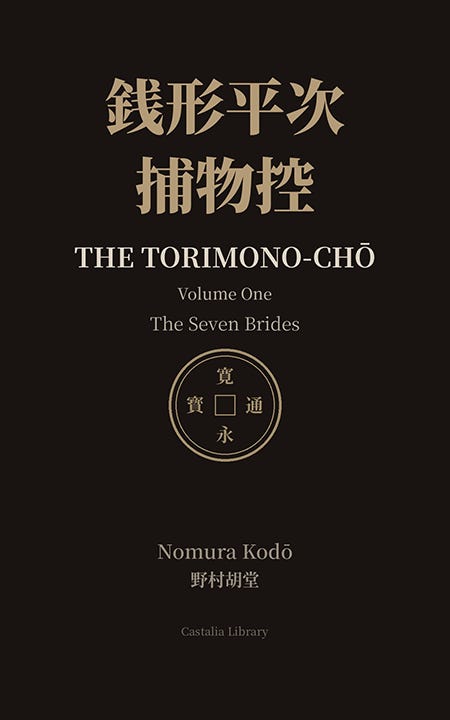
While only eight of the stories had been previously translated into English in an obscure paperback edition, Castalia House has already translated most of the 383 stories and will release them in a series estimated to be around 35 volumes.
An ebook of Volume One: The Seven Brides, has already been sent to all of the paid subscribers.
Excerpt
“I’ve been at this trade a long time, but I never get used to looking at the dead.”
Zenigata Heiji, the master thief-catcher, said this so often it might as well have been his motto. His nerves were a shade too fine for a man who made his living picking through blood-soaked corpses.
Which made it all the worse when he found himself standing over the most gruesome body of his career.
“Hachi, you dragged me into a hell of a spot.”
“I know it’s off our turf, oyabun, but the master of Hoteiya says he can’t trust Ishihara’s man. Wants you to take a look.”
“What a pointless errand.”
He clicked his tongue, but there was no shaking free now. He parted the reed blind of the pleasure boat moored at Yanagibashi and stepped inside. Blood everywhere.
By the uncertain light of the lantern Hachigoro held out, he could make out a young geisha lying on her back, a silver hairpin driven deep into her right eye.
Heiji turned away before he could stop himself. Young and beautiful, or she had been. The right half of her face was soaked in blood, and the sight was beyond anything.
“This is ugly.”
After a moment his professional instincts returned, and he moved closer. He straightened her legs where the scarlet hem had been kicked apart, and the first thing that caught his eye was her hand.
“She’s holding something,” Hachigoro said.
He didn’t need telling. He was already bending over the body. Clenched in the woman’s left fist was a man’s haori cord: thick, short silk braid of the kind in fashion then. She must have torn it loose in the struggle. The loop still carried a scrap of fabric where it had ripped from the jacket.
“Now there’s a lead.”
Hachigoro picked up the sheer summer haori tossed in the corner, the jacket the cord had come from, and held it up looking rather pleased with himself.
The woman’s hair had been grabbed and wrenched apart, her coiffure wrecked beyond saving, but there were no other wounds on her body.
The hairpin was a sturdy flat-headed piece with a shallow hawk-feather design engraved in the silver. Too plain and old-fashioned for a young geisha. The forked prong had been driven a good three inches into the eye socket. Unless someone had used a mallet, that took terrifying strength. How had the killer managed it? The question lodged in Heiji’s mind and stayed.
“Oyabun, the master of Hoteiya says he’d like a word with you.”
The man bending down from the bank to peer timidly into the boat was Kinbei, one of the jesters from the evening’s party.
“Tell him I’ll see him right here, if he doesn’t mind the scenery.”
“Yes, sir.”
Heiji tilted his head and studied the dead woman’s ruined coiffure. Through all the violence, a tortoiseshell comb and a second hairpin, coral-headed with a slender gold prong, had somehow stayed in place.
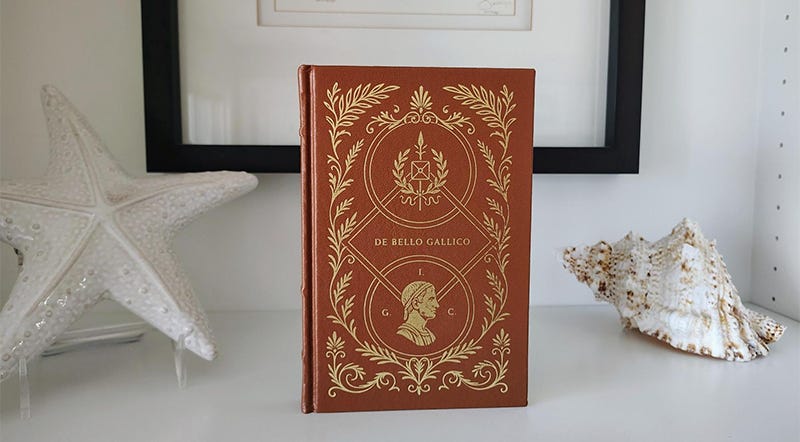
Castalia Library makes the world’s most beautiful leather books at its own bindery in Switzerland. Castalia House is the premier translator of never-before translated works from Japanese, Spanish, French, Italian, and German into English. To support Castalia House’s historic translation efforts and receive a new translated ebook every week, support the Alexandria project, and get future access to Castalia Unlimited, become a paid subscriber to this substack. And to receive a premium deluxe leatherbound book every three months, subscribe to Castalia Library.