


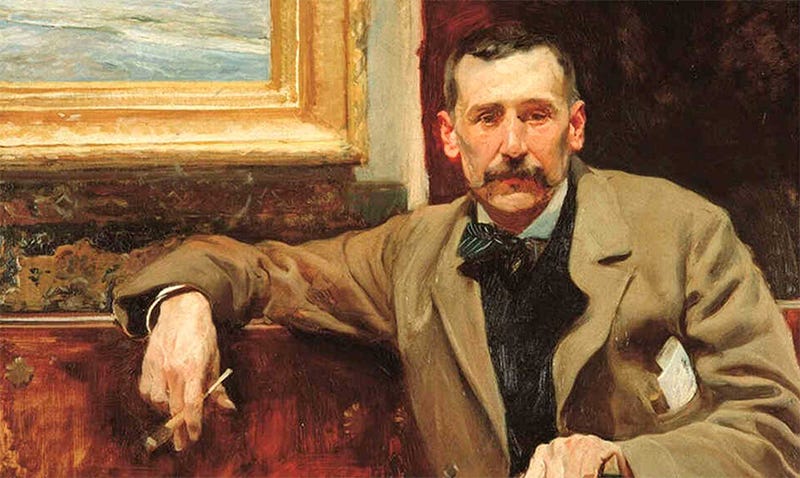
TRAFALGAR by Benito Pérez Galdós.
The first volume of the Episodios Nacionales — the great historical novel cycle of Spain
October 1805. Off the coast of Cádiz, the combined fleets of Spain and France sail out to meet the British under Nelson. By nightfall, the Spanish navy will have ceased to exist as a fighting force, and an empire that has ruled the seas for three centuries will have lost them forever.
Gabriel Araceli is fourteen years old. An orphan from the slums of Cádiz, he has been taken into the household of Don Alonso Gutiérrez de Cisniega, a retired naval officer who cannot bear to miss the coming battle. When Don Alonso slips away from his furious wife to join the fleet, Gabriel goes with him, and eventually finds himself aboard the Santísima Trinidad, the largest warship in the world, on the morning of the most catastrophic day in Spanish naval history.
What follows is one of the great battle sequences in European literature: the four-decker as living giant, the sand spread on the planks for the blood, the smoke that swallows the line, the slow agony of a ship that will not surrender and cannot be saved. Pérez Galdós, writing seventy years after the event with the aid of the testimony from the survivors of the battle, gives us a view of Trafalgar from the losing side, not as a British triumph but as a Spanish tragedy, narrated by an old man who was a boy in the rigging and has carried the day with him for the rest of his life.
Trafalgar is the first of forty-six novels in the Episodios Nacionales, Pérez Galdós’s vast fictional history of nineteenth-century Spain, a literary project on the scale of Balzac’s Comédie humaine, and one of the supreme achievements of European realism. Published in 1873, it has remained continuously in print in Spanish for over 150 years. Trafalgar is for fans of Patrick O’Brian, C.S. Forester, and Bernard Cornwell who are interested in seeing war in the age of sail from the other side of the line, and for those who love Tolstoy, Stendhal, and Hugo to encounter one of Spain’s greatest novelists for the first time.
Available for Kindle, KU, and audiobook on Amazon. The ebooks have already been sent out to the paid subscribers.
About the author. Benito Pérez Galdós (1843–1920) is widely regarded as the greatest Spanish novelist since Cervantes. Over four decades, he produced the Episodios Nacionales, one of the most incredible accomplishments of world literature ever written; only 8 of the 46 volumes have been translated into English. Pérez Galdós was nominated for the Nobel Prize in Literature five times but never won.

Excerpt
I trust I may be permitted, before recounting the great event I witnessed, to say something of my childhood, and to explain by what strange turn of fortune I came to be present at the terrible catastrophe that befell our fleet.
In speaking of my birth, I shall not imitate those who tell the story of their own lives by beginning with their families, noble as a rule, or hidalgo at the least, when they do not claim descent from the Emperor of Trebizond himself. For my part, I cannot adorn my book with resounding surnames; apart from my mother, whom I knew only briefly, I have no knowledge of any of my forebears save Adam, whose kinship with me seems beyond dispute. I begin my story, then, as Pablos does, the sharper of Segovia, though it is fortunate that God has willed we resemble one another in this alone.
I was born in Cádiz, in the famous barrio of La Viña, which is not today, and was still less then, an academy of good conduct. Memory sheds no light on my person or my actions in early childhood, save from the age of six; and I remember that age only because I fix it to a naval engagement I heard spoken of at the time: the Battle of Cape St. Vincent, which took place in 1797.
Casting a glance at what has been, with the curiosity and interest natural to a man observing himself, a confused and half-faded figure in the canvas of things past, I see myself playing on the Caleta beach with other boys of roughly my own age. That was for me the whole of life; more, the normal life of our privileged species. Those who did not live as I did seemed exceptional creatures of the human race, for in my childish innocence and ignorance of the world I held the belief that man had been created for the sea, Providence having assigned him as the supreme exercise of his body the art of swimming, and as the constant employment of his spirit the seeking and catching of crabs, whether to tear off and sell their prized claws, known as bocas de la Isla, or for one’s own satisfaction and sustenance, thus mingling the agreeable with the useful.
The society in which I was raised was as rough, primitive, and vile as may be imagined, to such a degree that we boys of the Caleta were held to be worse rogues than those who pursued the same trade and defied the elements with equal spirit at Puntales; and on account of this distinction, both factions considered themselves rivals, and from time to time we measured our strength at the Puerta de Tierra in great and noisy stone-fights that stained the ground with heroic blood.
When I reached an age to plunge headfirst into business on my own account, with the aim of earning a few honest coppers, I recall making a show of my cleverness on the quay, serving as introducer of ambassadors to the many Englishmen who visited us then as now. The quay was an Athenian academy for sharpening one’s wits in a few short years, and I was not among its least accomplished pupils in that vast branch of human learning; nor did I fail to distinguish myself in the raiding of fruit, for which the plaza of San Juan de Dios afforded ample scope to our initiative and lofty speculations. But I wish to draw a line under this part of my history, for I recall that degradation today with shame, and I thank God that He delivered me from it swiftly, setting me upon a nobler path.
Among the impressions I retain, the rapturous pleasure I felt at the sight of warships is fixed firmly in my memory, particularly when they anchored off Cádiz or at San Fernando.
The Translation Subscription
Sanshirō by Natsume Sōseki
Botchan by Natsume Sōseki
Kokoro by Natsume Sōseki
The Kamigata Scroll by Eiji Yoshikawa
The Edo Scroll by Eiji Yoshikawa
The Kiso Scroll by Eiji Yoshikawa
The Funaji Scroll by Eiji Yoshikawa
The Tsurugisan Scroll by Eiji Yoshikawa
The Naruto Scroll by Eiji Yoshikawa
Trafalgar by Benito Pérez Galdós
Beautiful prose. Makes me wish I could read in Spanish.
Purchased.
Castalia is single handedly adding to my TBR shelf faster than I can get through it.