


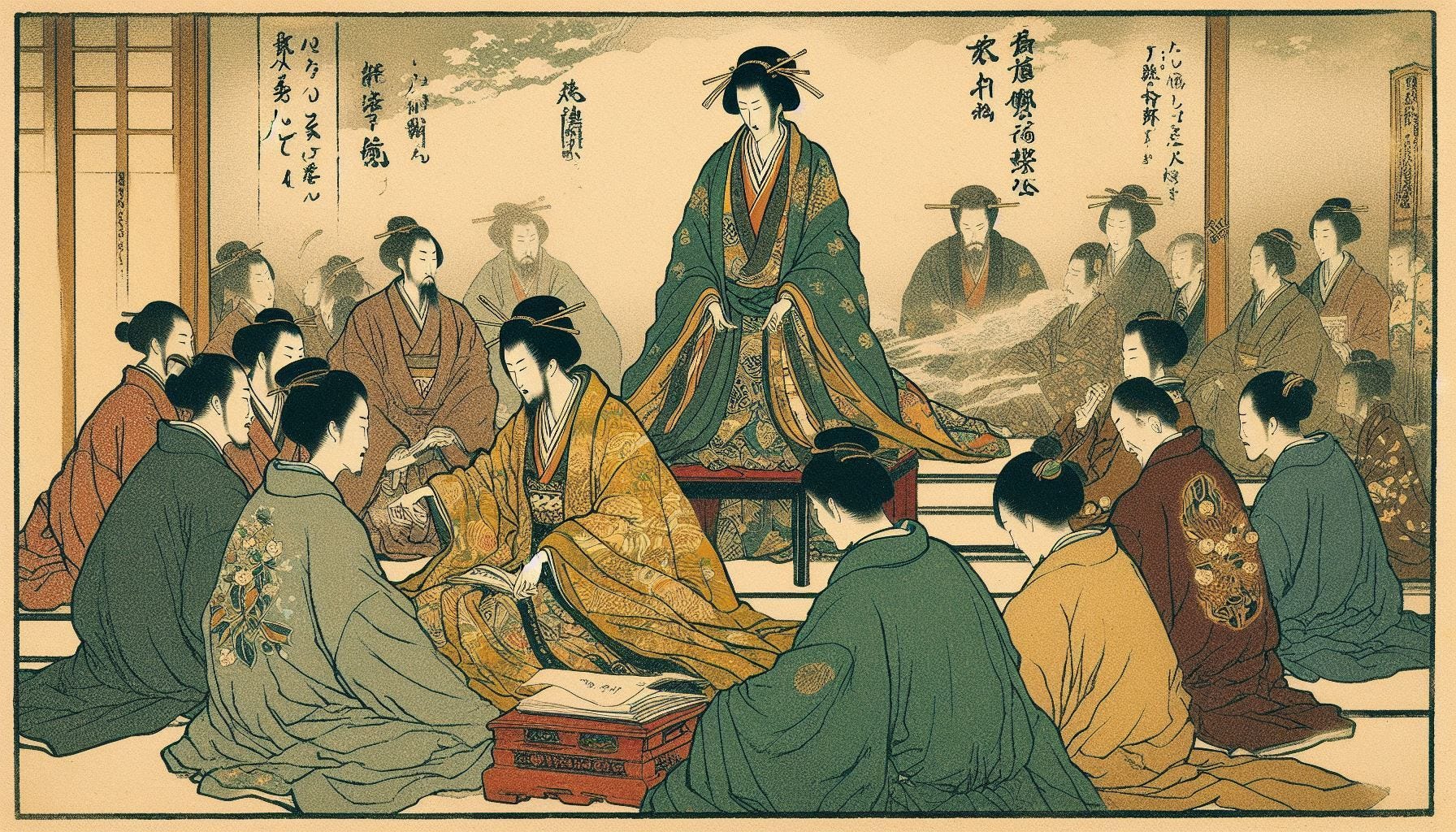
As you know if you are a Library or Libraria subscriber, THE TALE OF GENJI by Lady Murasaki Shikibu are the subscription books for October 2025 through March 2026. Written some 1400 years ago, GENJI MONOGATARI is the world’s first true novel, and one of the great classics of Man’s literature. And so, naturally, we want the Castalia Library edition to be something truly special.
One option, and the obvious solution, is to simply scan the 1933 Waley translation. Easton Press took that approach, and even mimicked the exterior design for the 1935 Houghton Miflin boxed set, and their oversized two-volume edition is one of their most attractive books they ever produced.
However, there are seven English translations, produced between 1882 and 2015, although only four of them are complete. So, in the interest of both a) pursuing the highest quality texts and b) listening to the subscribers, we’d like to ask you to read the sections from the following five translations and vote in the poll for your favorite.
And, of course, feel free to rank them from 1-5 or express a detailed opinion about any of them in the comments.
TRANSLATION #1
At the Court of an Emperor (he lived it matters not when) there was among the many gentlewomen of the Wardrobe and Chamber one, who though she was not of very high rank was favored far beyond all the rest; so that the great ladies of the Palace, each of whom had secretly hoped that she herself would be chosen, looked with scorn and hatred upon the upstart who had dispelled their dreams. Still less were her former companions, the minor ladies of the Wardrobe, content to see her raised so far above them. Thus her position at Court, preponderant though it was, exposed her to constant jealousy and ill will; and soon, worn out with petty vexations, she fell into a decline, growing very melancholy and retiring frequently to her home. But the Emperor, so far from wearying of her now that she was no longer well or gay, grew every day more tender, and paid not the smallest heed to those who reproved him, till his conduct became the talk of all the land; and even his own barons and courtiers began to look askance at an attachment so ill-advised. They whispered among themselves that in the Land Beyond the Sea such happenings had led to riot and disaster. The people of the country did indeed soon have many grievances to show: and some likened her to Yang Kueifei, the mistress of Ming Huang. Yet, for all this discontent, so great was the sheltering power of her master’s love that none dared openly molest her.
Her father, who had been a Councilor, was dead. Her mother, who never forgot that the father was in his day a man of some consequence, managed despite all difficulties to give her as good an upbringing as generally falls to the lot of young ladies whose parents are alive and at the height of fortune. It would have helped matters greatly if there had been some influential guardian to busy himself on the child’s behalf. Unfortunately, the mother was entirely alone in the world and sometimes, when troubles came, she felt very bitterly the lack of anyone to whom she could turn for comfort and advice. But to return to the daughter: In due time she bore him a little Prince who, perhaps because in some previous life a close bond had joined them, turned out as fine and likely a man-child as well might be in all the land. The Emperor could hardly contain himself during the days of waiting.* But when, at the earliest possible moment, the child was presented at Court, he saw that rumor had not exaggerated its beauty. His eldest born prince was the son of Lady Kokiden, the daughter of the Minister of the Right, and this child was treated by all with the respect due to an undoubted Heir Apparent. But he was not so fine a child as the new prince; moreover the Emperor’s great affection for the new child’s mother made him feel the boy to be in a peculiar sense his own possession. Unfortunately she was not of the same rank as the courtiers who waited upon him in the Upper Palace, so that despite his love for her, and though she wore all the airs of a great lady, it was not without considerable qualms that he now made it his practice to have her by him not only when there was to be some entertainment, but even when any business of importance was afoot. Sometimes indeed he would keep her when he woke in the morning, not letting her go back to her lodging, so that willy-nilly she acted the part of a Lady-in-Perpetual-Attendance.
TRANSLATION #2
In the reign of a certain Emperor—I forget which one—there was a woman among his many consorts who was not of the highest rank. She held no particular claim to precedence, yet she had completely taken hold of his heart.
The senior ladies, those who had entered the court by virtue of their birthright, watched her with contempt they barely troubled to conceal. She was an irritant, an obstacle, a mistake that would surely correct itself in time. The lesser consorts, those women who might otherwise have hoped to rise, resented her more keenly still: this interloper blocking the light. In the daily round of attendance the lady seemed only to accumulate hostility, drawing resentment the way wounds draw flies. Perhaps it was this constant pressure of so many wishing her ill that wore her body down. She grew frail, and began retreating to her family home as often as she could.
The Emperor, far from releasing her, loved her all the more helplessly for her fragility. He no longer cared what anyone said. His passion for her was becoming the kind of affair that endangers kingdoms.
Even the senior nobles averted their eyes. “This blinding favor,” they murmured. “In China, such obsessions have brought dynasties to ruin.” The whispers spread until they filled the realm, and people began to tell stories of Yang Guifei—that other emperor, that other ruinous love. The lady endured one humiliation after another, yet she had something to cling to: a devotion so absolute it had no precedent. She wrapped herself in it like armor, though the metal was soft and the blows kept coming.
Her father, a Grand Counselor of the Third Rank, was dead. Her mother came from old aristocratic stock and had raised her with exacting care. In refinement, in ceremony, the lady could hold her own against any woman of the court. But accomplishment without protection is a blade without a hilt. When her rivals turned against her, she had nothing on which to hold.
Her bond with the Emperor must have been forged in some former life, for she bore him a son, a boy of unearthly radiance, like a jewel made flesh. The Emperor could not contain his impatience; he had the child brought to court at once. One look at the boy’s face and he had understood at once that this was no ordinary infant.
The First Prince had every advantage of backing and position. He was the son of the Kokiden Consort, who was herself the daughter of the Minister of the Right. The court acknowledged him as the unquestioned heir. But set beside this luminous second son, even the heir apparent appeared somehow diminished. The Emperor treated the First Prince with all the formal respect his rank demanded, yet he cherished the younger boy as something private and precious, a treasure, not an obligation.
The lady had never been meant for common service. Her breeding was evident, her manner was that of the highest circles. But the Emperor held her too close. At every entertainment, at every refined occasion, he summoned her first. Sometimes he would not release her even after the night had passed, keeping her beside him through the following day, unwilling to let her leave his presence. This imperial possessiveness had always made her seem diminished in others’ eyes, a woman kept rather than honored. But after the boy was born, the Emperor’s intentions grew unmistakable. He treated the child with a gravity that had nothing to do with mere affection.
TRANSLATION #3
In a certain reign there was a lady not of the first rank whom the emperor loved more than any of the others. The grand ladies with high ambitions thought her a presumptuous upstart, and lesser ladies were still more resentful. Everything she did offended someone. Probably aware of what was happening, she fell seriously ill and came to spend more time at home than at court. The emperor’s pity and affection quite passed bounds. No longer caring what his ladies and courtiers might say, he behaved as if intent upon stirring gossip.
His court looked with very great misgiving upon what seemed a reckless infatuation. In China just such an unreasoning passion had been the undoing of an emperor and had spread turmoil through the land. As the resentment grew, the example of Yang Kuei-fei was the one most frequently cited against the lady.
She survived despite her troubles, with the help of an unprecedented bounty of love. Her father, a grand councillor, was no longer living. Her mother, an old-fashioned lady of good lineage, was determined that matters be no different for her than for ladies who with paternal support were making careers at court. The mother was attentive to the smallest detail of etiquette and deportment. Yet there was a limit to what she could do. The sad fact was that the girl was without strong backing, and each time a new incident arose she was next to defenseless.
It may have been because of a bond in a former life that she bore the emperor a beautiful son, a jewel beyond compare. The emperor was in a fever of impatience to see the child, still with the mother’s family; and when, on the earliest day possible, he was brought to court, he did indeed prove to be a most marvelous babe. The emperor’s eldest son was the grandson of the Minister of the Right. The world assumed that with this powerful support he would one day be named crown prince; but the new child was far more beautiful. On public occasions the emperor continued to favor his eldest son. The new child was a private treasure, so to speak, on which to lavish uninhibited affection.
The mother was not of such a low rank as to attend upon the emperor’s personal needs. In the general view she belonged to the upper classes. He insisted on having her always beside him, however, and on nights when there was music or other entertainment he would require that she be present. Sometimes the two of them would sleep late, and even after they had risen he would not let her go. Because of his unreasonable demands she was widely held to have fallen into immoderate habits out of keeping with her rank.
TRANSLATION #4
In a certain reign (whose can it have been?) someone of no very great rank, among all His Majesty’s Consorts and Intimates, enjoyed exceptional favor. Those others who had always assumed that pride of place was properly theirs despised her as a dreadful woman, while the lesser Intimates were unhappier still. The way she waited on him day after day only stirred up feeling against her, and perhaps this growing burden of resentment was what affected her health and obliged her often to withdraw in misery to her home; but His Majesty, who could less and less do without her, ignored his critics until his behavior seemed bound to be the talk of all.
From this sad spectacle the senior nobles and privy gentlemen could only avert their eyes. Such things had led to disorder and ruin even in China, they said, and as discontent spread through the realm, the example of Yōkihi1 came more and more to mind, with many a painful consequence for the lady herself; yet she trusted in his gracious and unexampled affection and remained at court.
The Grand Counselor, her father, was gone, and it was her mother, a lady from an old family, who saw to it that she should give no less to court events than others whose parents were both alive and who enjoyed general esteem; but lacking anyone influential to support her, she often had reason when the time came to lament the weakness of her position.2
His Majesty must have had a deep bond with her in past lives as well, for she gave him a wonderfully handsome son. He had the child brought in straightaway,3 for he was desperate to see him, and he was astonished by his beauty. His elder son, born to his Consort the daughter of the Minister of the Right, enjoyed powerful backing and was feted by all as the undoubted future Heir Apparent, but he could not rival his brother in looks, and His Majesty, who still accorded him all due respect, therefore lavished his private affection on the new arrival.
Her rank had never permitted her to enter His Majesty’s common service.4 His insistence on keeping her with him despite her fine reputation and her noble bearing meant that whenever there was to be music or any other sort of occasion, his first thought was to send for her. Sometimes, after oversleeping a little, he would command her to stay on with him, and this refusal to let her go made her seem to deserve contempt;5 but after the birth he was so attentive that the mother of his firstborn feared that he might appoint his new son Heir Apparent over her own.
TRANSLATION #5
IN WHOSE reign was it that a woman of rather undistinguished lineage captured the heart of the Emperor and enjoyed his favor above all the other imperial wives and concubines? Certain consorts, whose high noble status gave them a sense of vain entitlement, despised and reviled her as an unworthy upstart from the very moment she began her service. Ladies of lower rank were even more vexed, for they knew His Majesty would never bestow the same degree of affection and attention on them. As a result, the mere presence of this woman at morning rites or evening ceremonies seemed to provoke hostile reactions among her rivals, and the anxiety she suffered as a consequence of these ever-increasing displays of jealousy was such a heavy burden that gradually her health began to fail.
His Majesty could see how forlorn she was, how often she returned to her family home. He felt sorry for her and wanted to help, and though he could scarcely afford to ignore the admonitions of his advisers, his behavior eventually became the subject of palace gossip. Ranking courtiers and attendants found it difficult to stand by and observe the troubling situation, which they viewed as deplorable. They were fully aware that a similarly ill-fated romance had thrown the Chinese state into chaos.
Concern and consternation gradually spread through the court, since it appeared that nothing could be done. Many considered the relationship scandalous, so much so that some openly referred to the example of the Prize Consort Yang. The only thing that made it possible for the woman to continue to serve was the Emperor’s gracious devotion.
The woman’s father had risen to the third rank as a Major Counselor before he died. Her mother, the principal wife of her father, was a woman of old-fashioned upbringing and character who was well trained in the customs and rituals of the court. Thus, the reputation of her house was considered in no way inferior and did not suffer by comparison with the brilliance of the highest nobility. Unfortunately, her family had no patrons who could provide political support, and after her father’s death there was no one she could rely on. In the end, she found herself at the mercy of events and with uncertain prospects.
Was she not, then, bound to the Emperor by some deep love from a previous life? For in spite of her travails, she eventually bore him a son—a pure radiant gem like nothing of this world. Following the child’s birth His Majesty had to wait impatiently, wondering when he would finally be allowed to see the boy. As soon as it could be ritually sanctioned, he had the infant brought from the home of the woman’s mother, where the birth had taken place, and the instant he gazed on the child’s countenance he recognized a rare beauty.
We’d like to get everyone’s opinion on which translation they found to be their preferred one. Not all of them are available to us for our own Library edition of GENJI MONOGATARI, but we do have several options.
We’ll announce the results of the poll and identify each of the five translators tomorrow. Please be aware that the winner of the poll will not necessarily be indicative of which translation we will use for the Library edition, since not all of them are readily available for our use.
I really dislike 2. It feels too modern and maybe not the author's true voice for the time period. I really wish i knew how to read japanese so i could tell.
I liked 2 the most, so I voted for it.
BUT, I'm not sure that's the right metric. I strongly suspect that of all these translations, #1 is the most faithful to the original. Vox's background puts him in in a far better position to judge - and if that is so, I would disregard "vox populi, vox dei" and turn to Translation #1 for Castalia.