



As longtime subscribers will recall, problems with the bindery we used to use to manufacture Castalia Library books are not exactly new. Whether it was something simple like making sure the hubs on the spine all line up, or something more complicated like tracking numbers being issued without any books actually shipping, the problems we kept running into eventually led us to build our own bindery.
Now Dragonsteel Books is discovering the joys of working with a bindery that doesn’t necessarily have the same dedication to quality control that one might tend to prefer, as Fandom Pulse announces the temporary shutdown of production at Dragonsteel.
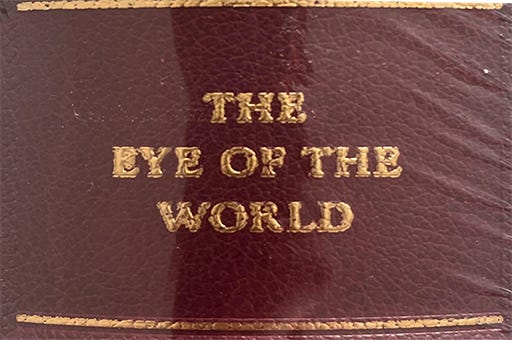
Brandon Sanderson’s Dragonsteel Books has temporarily halted all production, binding, and shipping of The Eye of the World leatherbound edition following a concerning number of manufacturer defects reported by customers who’ve already received their copies.
The announcement came in Sanderson’s weekly YouTube update, where he addressed the situation directly and at length. For a company that has built its reputation on premium collector’s editions, the news is significant. These books retail at $185 each, and customers expect a product that matches that price point.
“As I tweeted last week, we’ve noticed that there’s a concerning number of manufacturer defects coming in the copies people are getting,” Sanderson said. “And this is very concerning to us. I love this book. I love the version of Eye of the World we made. And we spent a really long time—you’ll remember how long it took us to get to even pre-orders—making sure that the binder was able to do these books the way we wanted to.”
What’s Going Wrong
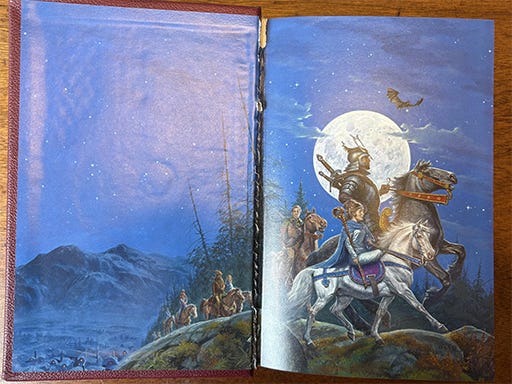
Reports on Reddit’s r/brandonsanderson community have documented several specific defects appearing in copies already delivered. Known issues include cover quality problems, art pages glued together incorrectly, and gaps between binding signatures—the sections of pages that make up a bound book.
These aren’t minor cosmetic issues. Gaps between binding signatures suggest structural problems with the binding itself. Art pages glued together incorrectly means customers are receiving damaged interior content. Cover quality problems on a $185 premium leatherbound edition represent a fundamental failure to deliver the product customers paid for.
The scope of the problem is what’s most alarming. Every manufacturing run produces occasional defects. What Sanderson is dealing with appears to be a systemic issue affecting a significant portion of the print run.
These problems are not a surprise. We’re still working to resolve a production problem that was created unnecessarily by the bindery related to Volumes 1-8 of The Junior Classics.
Based on the pictures, it looks as if there are four distinct problems, three of which are sporadic and one of which is systemic. The most serious problem appears to be with the book blocks, as they don’t appear to have been pressed or sewn properly. That’s not something that just happens occasionally, as with the stamp shouldering, the glue failing to hold, or the way in which some of the stamp depths appear to be uneven on some books and even on others.
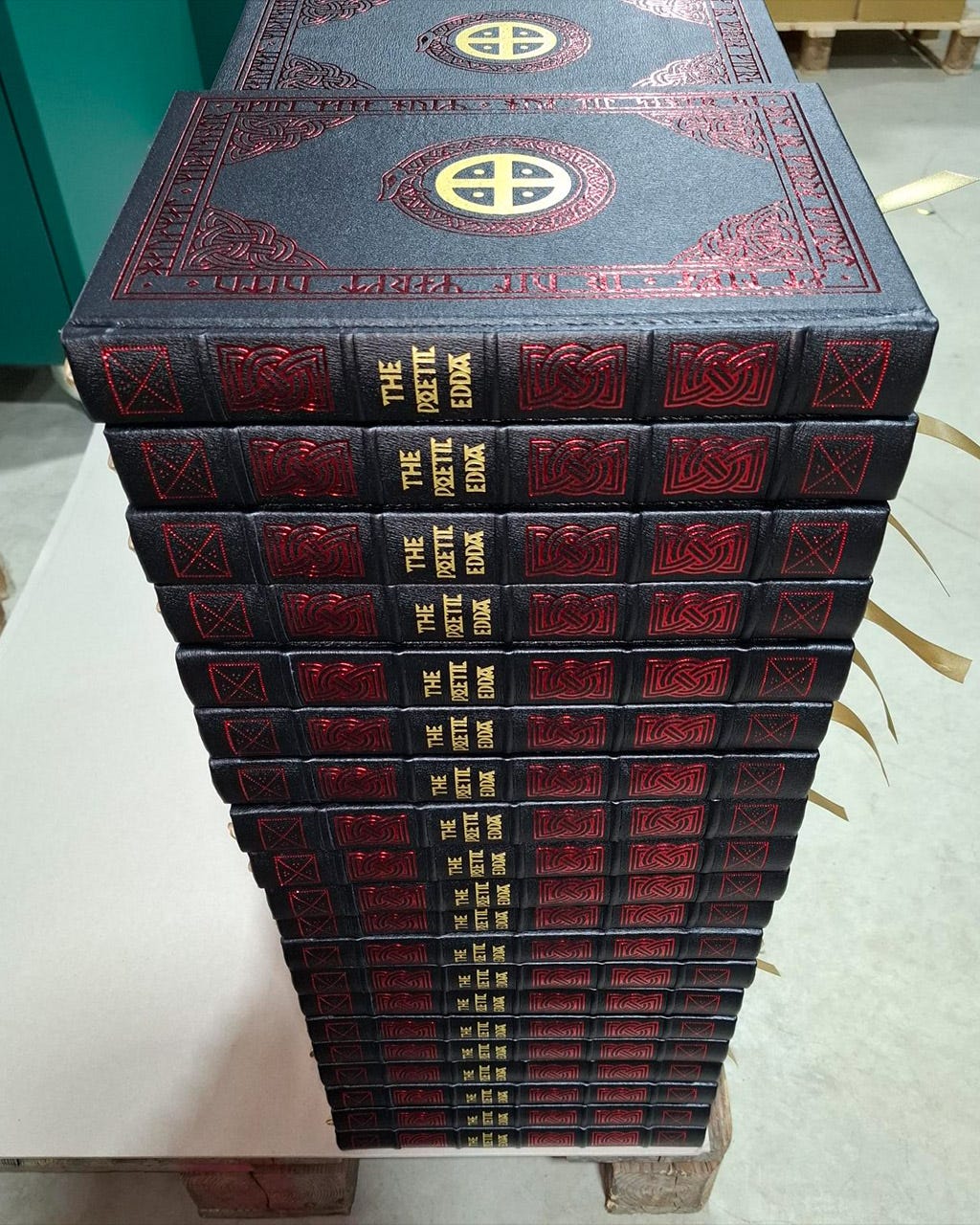
No binding process is perfect. We had three books in our most recent print run fail the glue test; fortunately the failures were complete rather than catastrophic so it was possible to simply reglue them. But the “spot check” approach to which the printer, the bindery, and Dragonsteel itself are utilizing just isn’t a substitute for checking every single book, every single time, as we learned when a handful of Byzantine Histories separated from their covers after reaching their final destinations.
Dragonsteel is a good company. We have nothing but sympathy for the challenges their facing because we have experienced those, and considerably more, ourselves over the last six years. They’ll replace the books, just as we did when we discovered issues with the quality of a few of our books in the past, but it’s a lot more expensive to discover a problem once the books have left the bindery than to test all of them, methodically, at each step of the process
UPDATE: The problem of the endpapers and second pages torn down the middle is a casing-in problem. The machine was set too tight for the size of the book, putting stress on that joint while the paper was weak from the glue being set. This is one reason why we set 800 pages as our limit, since the weight of the gilded, heavy paper puts stress on the glued endpapers. This is why we published A THRONE OF BONES and A SEA OF SKULLS, as well as PLUTARCH’S LIVES, WAR AND PEACE, and THE TALE OF GENJI in two volumes instead of one. It most likely affects one in every six books produced, and it cannot be easily fixed.
The signature gap problem is just carelessness in the Smythe-sewing of the book blocks. This could, in theory, affect all of the books, although reports don’t seem to indicate that’s the case. There really isn’t any excuse for that; literally everyone who ever handled one of the book blocks should have noticed it immediately.
"just as we did when we discovered issues with the quality of a few of our books in the past" -- and how!
For those of you fortunate enough not to encounter quality problems, I hit one with the test print of Meditations. Reached out, showed a photo, "we'll ship you a new one", and they did exactly that. It was that easy. Thank you again, Castalia, for your excellent service, and Jordan in particular, as he made it easier than I've ever experienced in dealing with a faulty product.
Same issue happened with one of my Byzantines. It sits on the bookshelf with its brother, waiting to be replaced and then sent back for book rehab.