


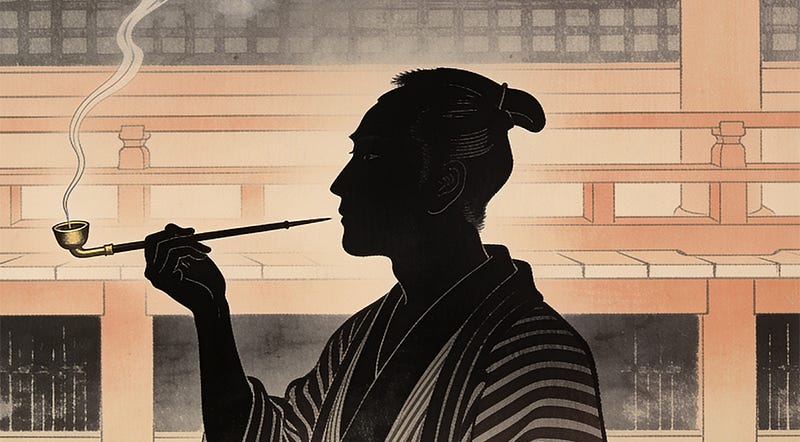
Castalia House has just completed translating the first volume of the complete Casebook of Hansichi, Japan’s answer to Sherlock Holmes. Volume I: The Ghost Master, will be next week’s subscription ebook, in case that inspires you to take out a paid subscription here, and it will be available via Kindle and KU, as per usual.
We’re very, very excited about this project, very nearly as much so as we are about the Episodios Nacionales, because the Hanshichi stories are every bit as original and clever as the Conan Doyle stories that inspired them, and their setting in historical Edo renders them even more intriguing. It also happens to be the centenary of their original publication. And while there is one previous English translation of 14 of the stories, it’s an academic one, and the other 55 stories remained untranslated until now. Castalia House will publish all of them in seven volumes, first in ebook, then in print.
But rather than speak for him, why not let Okamoto-sama speak for himself, as he explains why he began writing the Hansichi stories almost exactly 100 years ago.
It was around April of 1916, as I recall, that I first conceived the idea of writing the Hanshichi Casebook. I had been reading Conan Doyle’s Sherlock Holmes stories here and there for some time but had never read them straight through from beginning to end. One day, having occasion to visit the Maruzen bookshop, I bought three volumes — the Adventures, the Memoirs, and the Return — and read all three at a single sitting. A keen interest in detective fiction welled up in me at once, and I found myself seized by the desire to try my hand at the form. I had read Hume and others before, of course, but it was Doyle who truly struck the spark.
I was not yet free to begin, however. I went on hunting down more of Doyle’s writings and set about reading The Last Galley, The Green Flag, The Captain of the Polestar, the Round the Fire Stories, and various other collections of his short fiction, one after another. But I had my own work to attend to: I was preparing a serial novel for the Jiji Shinpō at the time, and my reading did not progress as quickly as I would have liked. From when I had started it took roughly a month, and it was late May before I finished the lot.
When at last I sat down to write, what struck me was this: no one had ever written detective fiction set in the Edo period. The tales of Ōoka and Itakura were fundamentally adjudication records, concerned with trials and judgments rather than with investigation, and it seemed to me that a story built around detection itself would make for something fresh. There was a further consideration. Writing detective fiction set in the present day carried the constant risk of lapsing into imitation of Western models, whereas committing to a purely Edo-period mode might yield something with a flavor all its own. I was fortunate in possessing a reasonable working knowledge of Edo customs, manners, and statutes, as well as the world of the city magistrates, their constables and inspectors, and the network of private thief-takers. Enough, I felt, to manage tolerably well.
On the third of June that year I began writing. First came “The Spirit of Ofumi,” forty-three manuscript pages; then “The Stone Lantern,” forty pages; then “The Death of Kanpei,” forty-one. At that point I found myself committed, from August onward, to a serial novel for the Kokumin Shinbun. Writing simultaneously for the Jiji and the Kokumin left no room for the casebook, and it was set aside. Then Mori Gyōkō, who was serving as chief editor of the literary magazine Bungei Kurabu, wrote to ask whether I might contribute something for serialization. I offered the three completed stories under the collective title “The Casebook of Hanshichi,” and they began appearing from the New Year’s issue of 1917. Through January and the months following I continued writing, adding “Upstairs at the Bathhouse,” “The Ghost Master,” “The Mystery of the Fire Bell,” and “The Lady-in-Waiting” to the series. In the magazine the run extended from the New Year’s number through the July issue.
This was my first venture into detective fiction, and I was conscious throughout of groping my way forward with rather uncertain hands. The stories found favor with readers, however, and Mori pressed me for more. Over the first half of the following year I produced another six installments. After that, commissions arrived from one magazine and newspaper after another, and the casebook grew into something far larger than I had ever foreseen. To date I have published approximately forty stories.
“Is old Hanshichi a real person?” This is a question I receive with some frequency. There were models of a sort, I will admit, but Hanshichi is in the main a creature of my imagination, and I would ask the reader to understand him as such. I am told that various people have claimed to know him, that his son has been variously identified as a dentist and as a watchmaker, and that one gentleman has gone so far as to announce that he himself is Hanshichi. These are, I must suppose, persons who happen to share the name and have no connection whatsoever to the old detective of my casebook. I should like to make that quite clear.
As I mentioned, the casebook first appeared in Bungei Kurabu in January of 1917, which, looking back, means more than ten years have passed. Writing these reminiscences for the pages of that same magazine, I find myself struck afresh by how swiftly the years have gone.
Okamoto Kidō
Tokyo, 1927
Ahhhmazin!!
Amazing. Can't wait to check the out when I'm done reading everything in my queue.