


First, let me point out that the primary purpose of this substack is to support the Castalia Library, which includes the bindery, the four official subscriptions, and the special editions that we’re producing. Which is to say that the free subscribers here are, and always will be, the primary focus of this site.
So feel absolutely zero obligation or pressure to ever become a paid subscriber here. It’s not necessary, it’s not required to keep this thing in operation, and the single most important reason for you to subscribe here for free is to always be informed as to what is going on with regards to the production of the most beautiful books in the world.
That being said, things sometimes take on secondary purposes. And the secondary purpose here happened to evolve out of the primary purpose due to the realization that Castalia Library could produce new and original translations that are superior to the public domain translations that are otherwise available to us. It was a very pleasant surprise to discover that we could also produce new and original translations that reliably turn out to be superior to the copyright-protected translations that we would have to license and get permission in order to use.
You may recall that when we took a poll here of five different translations of Genji Monogatari, our new translation was by far the preferred one. We’ve since finished that translation, it has tested as superior to all of the previous translations, and it will be the translation we utilize for the two-volume set being produced for the Castalia Library subscription.
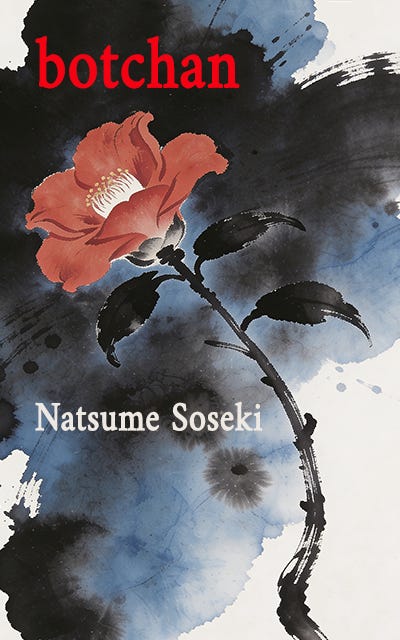
As it happens, we’ve developed a very powerful translation tool that has permitted us to not only translate a number of previously translated works, such as Kokoro, Sanshiro, and Botchan by Natsume Soseki, now that it’s been properly calibrated against existing translations - and not always favorably, as it turns out that Jay Rubin’s translation of Sanshiro is simply superior to our best efforts - but we’re now able to tackle previously untranslated works, including some of the most famous works of Japanese literature.
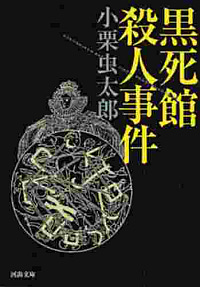
The canonical great novels of Japanese detective fiction are the 三大奇書, the "three great strange novels," sometimes expanded to four. Oguri Mushitarō's Kokushikan Satsujin Jiken (黒死館殺人事件, 1934–35) is a locked-mansion mystery in which the detective's method is erudition itself, burying the reader in heraldry, cryptography, occultism, and musicology, much of it brilliantly garbled. Yumeno Kyūsaku's Dogra Magra (ドグラ・マグラ, 1935) is a psychiatric nightmare in which the narrator may be a mental patient, a murderer, or both, structured around a fictional academic paper and a centuries-old scroll, with the reader's own sanity as the real victim. Nakai Hideo's Kyomu e no Kumotsu (虚無への供物, 1964) is a metafictional murder mystery set in postwar Hakodate in which the characters are aware they are in a detective novel and attempt to control the genre's conventions, written across nearly two decades and published under circumstances almost as strange as the novel itself. The sometimes-added fourth is Takemoto Kenji's Igyō no Kubi no Monogatari (匣の中の失楽, 1978), though this designation is less universally accepted. What unites them is not mystery in the conventional whodunit sense but mystery as intellectual derangement — each uses the detective-fiction framework to produce something that dissolves the reader's confidence in reason, narrative, and reality itself.
We have already translated Kokushikan Satsujin Jiken and it is quite literally insane. Imagine Umberto Eco and Edgar Allen Poe collaborated on an Agatha Christie-style murder mystery while on an absinthe-and-cocaine bender. It is, in a word, mind-bending. It may well be in my twenty favorite books ever read although I’m not sure; it’s the sort of book you probably need to read two or three times before you’re even certain what you think about it.
Anyhow, we’re obviously not going to be releasing all of these translations in leather editions, not unless there is much bigger demand for them than we tend to imagine. But what we will do is provide ebook editions of all of these translations to the paid subscribers of this substack; obviously subscribers to the leather editions will be receiving the ebook versions of those books as well.
The first book that will go out to subscribers will be Botchan, which is already complete and just needs a little ebook formatting to be ready for release. It will also be published as an ebook at some point in time. The second will be Sanshiro, which will be sent to subscribers, but we may not bother to publish since the Rubin translation is already available. Perhaps we’ll let the subscribers decide if it’s worth it or not. The third book will be Kokushikan, most likely in April, as our goal will be to provide subscribers with at least one new translation every month.
Other books we’re planning to translate are Narzissus und Goldmund from the German, Dogra Magra from the Japanese, and Il marchese di Roccaverdina from the Italian. We already have a long list of 30 or more books we’re planning to translate, most of which have never been translated before.
Again, no pressure. The number of current paid subscribers here already pays for the necessary usage time, and we’re on the verge of a breakthrough that might speed up our process by a factor of 10 without harming the quality. But if you’d like to be a part of this undeniably valuable work, now you know how to do so.
I told my English class ( in Nippon) about the improvement of the translation, of The Genji and Kokoro …
… wish you could have seen their reaction! Well done Vox and team!
I look forward to purchasing the e-editions when they wind their way to Castalia House's own purchasing site in epub form. They'll wait. Godspeed.